Bereshit
By Dr. Esti Doron
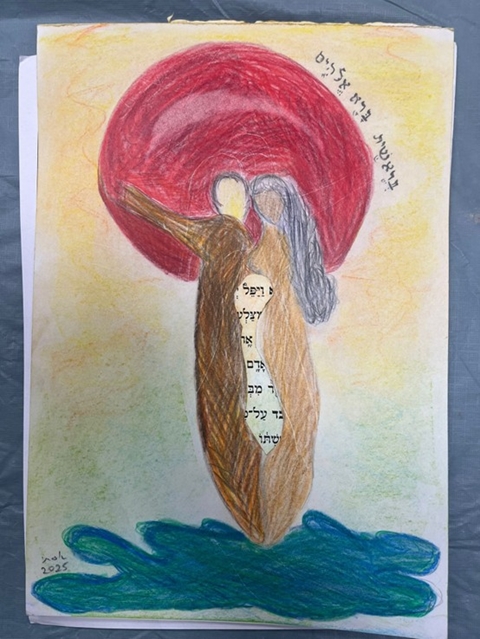
I have debated a lot about what to write about in the Book of Genesis. A chapter that contains five stories (the creation of the world, the creation of Adam and Eve, the Garden of Eden, Cain and Abel, and the association of angels with the daughters of man) on each of which, individually, one could write entire pages, and each story evokes different emotions, countless questions and interpretations. Dozens of paintings have been painted about each of the stories, most of which came mainly from Christian culture, and many poems have been written, both in world culture and in contemporary Israeli culture.
I decided to share a few points I've been thinking about, which are very relevant to these days.
1. Parashat Bereishit begins the Torah reading cycle immediately after the conclusion of the last parasha in the Pentateuch. The parasha is adjacent to the end of the month of Selichot and the High Holy Days, Rosh Hashanah, the Ten Days of Repentance, and Yom Kippur. There is a connection between the processes of repentance, atonement, and correction and the beginning from Genesis. And what is the beginning from Genesis? To remember that we were created in the image of God, that we received the world to serve and preserve, and that we must correct everything that needs correction in the world. This connects to the last two years in particular, with our desire to rebuild Israeli society, to rise from the great rift of the October 7 massacre, and to begin building a more just and equitable society here.
2. The Torah emphasizes that it is not good for man to be alone. The creation of woman alleviates man's loneliness. And the LORD God said, It is not good that the man should be alone; I will make him a helper suitable for him.: But not only a woman helps loneliness, but a community, a sense of togetherness. We live in a time when loneliness is more present than ever, and psychologists claim that loneliness is the silent plague of our century. (The reasons that led to this are not new; the breakdown of the clan structure and the breakdown of communities, the breakdown of the ancient family structure and the introduction of technology). Another place where loneliness could be present is in the struggle of the families of the kidnapped. One of the reasons I make sure to participate in the demonstrations in "Kachar Hatofim" is related to this fact. "You are not alone! We are with you" I shout at the top of my voice every Saturday. You are not alone. There is a community around you. People see you! We strengthen you. We are the "help" against you!
3. The story of Cain and Abel is the story of the first murder in the Bible. And not just any murder – but a murder within the family between two brothers. The Torah does not specify the reasons for the murder. And Cain said to his brother Abel, and they were in the field; and Cain rose up against his brother Abel and killed him. This story is supposed to be a warning sign of what can happen when brothers are jealous and do not get along with each other. But suddenly I feel that it also normalizes the fact that such a murder can happen. And if between brothers it is normative, how much more so between people of the same nation, who are currently in a deep polarization and the extremization of all emotions and hatreds. How do we turn this sign of Cain, this warning, into the greatest threat to the integrity of our society? About our ability not to reach a civil war?
4. We must strive to be moral. We were created "in the image of God." The strange story of the connection between the sons of God and the daughters of man proves how difficult it is to work on our virtues, to be moral all the time, to forget about the impulses of greed, envy, revenge, and competition. Even the angels sin. So we as humans are all the more so. This connects me to a place that emphasizes the Judaism of kindness and the Judaism between man and his neighbor. This connects me to the Psalm of Psalms 34:13-15. Who is the man who desires life? His tongue is created from evil and his lips speak deceit, he turns away from evil and does good, seeks peace and pursues it. In my opinion, this is true Judaism. Judaism between man and his neighbor. Judaism that emphasizes the values of morality and kindness. This is the Judaism that I choose.