Parashat Balak (another one of the Torah portions named after a person, and in this case, also after a non-Israelite – and moreover, an enemy) deals with Balak's attempt to harm the Children of Israel through a curse to be invoked upon them by "Bileam son of Beor" (who in my imagination appears as the character of Jafar from the movie Aladdin, with the donkey in a guest role). Balak asks Balaam to curse the people of Israel in a number of ways, and his frustration grows as the portion progresses.
Balak's original request of Balaam is – "Now therefore, I pray thee, come curse me this people… for I know whom thou blessest is blessed, and whom thou cursest is cursed." This request changes later, and Balak asks to curse the people of Israel, instead of to bless – "Behold, the people that cometh out of Egypt: and behold, they cover the face of the land: now therefore come, curse me them…; Come now therefore, curse me this people"; "What shall I curse, whom God hath not cursed?"; "... to curse mine enemies I have taken thee, and behold, thou hast blessed them altogether..." and so on.
Regarding the meaning of the word "lakov," Rashi writes: "'Kavah li, this is a harsh curse for me, for he pierces and explains.'" Piercing is to reach the root of the matter, piercing and explaining. R. Shimshon Raphael Hirsch explains – just as the meaning of "nakev" is to make a hole, so the meaning of 'kavah' is, seemingly, to drill a hole until the object becomes hollow, and therefore 'kav' is a measure of volume., The space a body occupies in space, and therefore, if 'pierce' means to damage things, then 'to hollow out' means to strike something until it is completely hollowed out, taking all its contents...'.
Balaam, the evil-eyed one, wants to show that the foundation of the people of Israel is actually hollow, empty. Although the Israelites appear to be full of values, in reality, if we look deeply, we will discover that everything is hollow and lacking.
The Gemara explains that Bilam's expertise was identifying the moment when God is angry, that moment when there seems to be no foundation. Bilam tries once, tries twice, and towards the end, Balak despairs and tells him
"Even if you don't pierce it, even if you don't bless it" - If you are unable to perform the task, At least don't mess it up.
But nothing lasts forever. When Balaam failed to expose the emptiness and deficiency within the people of Israel, he turned to show it by tempting the Israelites to sin with the daughters of Moab, which would prove their inner emptiness.
And indeed, some are tempted. However, Pinchas (whose behavior also raises difficult questions) wants to show through his zeal that there are actions that have no place in the camp.
Here the expression of Balaam's "cursing" is repeated: "And the Israelite went in to..." The Holy One, Blessed be He He struck both of them, the Israelite man and the woman Kabbalah 'And the plague was stopped among the children of Israel…" Pinchas's war, in his view, is a war against those who tear at social cohesion.
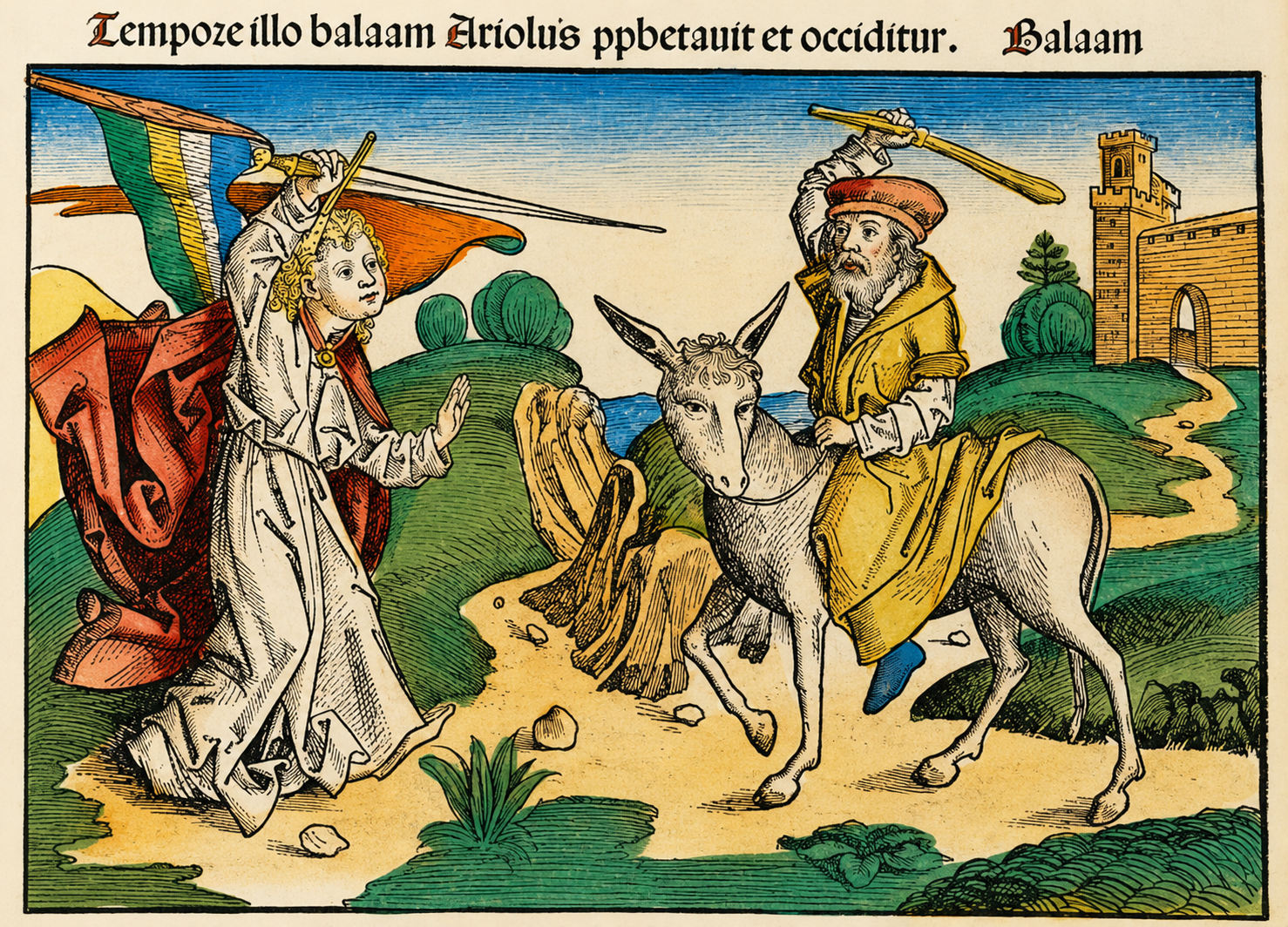
Concurrently, within the frame story of Balaam and Balak, a secondary but critical story appears about Balaam's donkey. Balaam rides his donkey on the way to curse the people of Israel, full of self-confidence and a sense of power.
An angel stood on the road with a drawn sword, but only the donkey saw him. The donkey turned off the road, pressed against the wall, and finally lay down beneath him to save Balaam. Balaam did not understand why she was stopping and beat her with his stick three times. Creator of the World opens the donkey's mouth, and she asks him: """What have I done to you that you have struck me these three times??".
Balaam's eyes are opened to see the angel, and he understands that the donkey saved his life.
The miraculous yet perplexing story contains several significant moral messages that can be adopted in daily life.
The Dangers of Pride and Hubris
Balaam is considered a great prophet, "one who knows the knowledge of the Most High," but his desire for money and honor blinded him. The donkey saw the spiritual reality long before the great prophet.
From here, an action driven by anger, ego, or lust can blind us to the reality around us and cause us to miss the simple truth.
Animal welfare and compassion
The story is one of the main sources in the Torah for the obligation to care for animals. The donkey served Balaam faithfully for many years, but the moment it did not behave as he expected, he cruelly beat it without trying to understand its behavior.
The (unsubtle) message – we must show compassion towards the helpless (humans and animals alike) and not attack them as a solution to our frustration. Our abilities do not belong only to us.
Balaam boasted about the power of his speech and his ability to curse and destroy nations. The Creator of the world opened the mouth of the donkey to make it clear to Balaam that his power was a gift and a trust. Sometimes even an animal is capable of conveying a critical message.,
And even the greatest prophet cannot always understand.
Our talents and abilities are a deposit in our hands and at our disposal, and we should strive to use them for good. Many of us, especially in the complex reality we live in, have a "yes, but" tendency, and we find ourselves looking for what's missing and what's bad (the hole) in reality, even when it's good. Perhaps we can adopt Balaam's inversion of intentions and seek, see, and bless the good, even when reality is complex and much appears bad. And sometimes, even if the person speaking to us seems like a donkey – it's still worth listening.
Shabbat Shalom!