Judges network – how do we protect our goals?
Parashat Shoftim opens with the commandment: "You shall appoint judges and officers for yourself in all your gates, which the Lord your God is giving you, throughout your tribes, and they shall judge the people with righteous judgment" (Deuteronomy 16:18).
Why does the Torah command that there be both judges and officers? What is the difference between them, and why is one of them not sufficient?
Rashi explains: "Judges — judges who render the verdict; and officers — those who compel the people to follow their commandments." The judge listens, examines the evidence, interprets the law, and decides what the ruling is. The officer is entrusted with bringing the decision from potential to actual. The judge determines what is right to do; the officer ensures that it is indeed done.
Midrash Tanchuma phrases it sharply: “Rabbi Eleazar says: If there is no enforcer, there is no judge” (Midrash Tanchuma, Shoftim 2). That is, if a person was found liable in court but refuses to comply with the verdict, the judge can do nothing without the enforcer to execute the ruling. Justice that has no way to be realized in reality is liable to remain a beautiful and helpless idea. A society cannot suffice with proper laws and just verdicts; it also needs the power to protect and enforce them.
However, the words of the Midrash also raise the opposite question: if there is no police officer – there is no judge: what is a police officer who has no judge above him?
A police officer who is not subject to the law is no longer someone who carries out a reviewed and deliberated judgment. He becomes a force that determines the limits of his own action: whom to protect, whom to arrest, against whom to use force, and which injustice to ignore. Without a judge, without review, and without the obligation to explain and justify his actions, the police officer may cease to serve the law and become the law himself.
Perhaps that is why the Torah is not content with the words "judges and officers," but concludes: "and they shall judge the people with righteous judgment." Maintaining order is not the goal, nor is enforcement an end in itself. The goal is justice. A society can be very orderly and regimented and yet still be unjust. The Torah demands that power serve the law, and that the law serve justice.
The idea of judges and officers can also be taken inward, into the human soul. The holy Shelah, Rabbi Isaiah Horowitz, who lived in the 16th and 17th centuries, reads the verse not only as a commandment for building a society, but also as an instruction for the spiritual work of the soul. He interprets the words "in all your gates" as an allusion to the seven gates in a person's face: the two eyes, the two ears, the two nostrils, and the mouth. These are the gates through which we encounter the world, taking in sights and sounds and uttering words from within us. Upon these we must place: judges and officers.
How true his words are for our times. We must guard our eyes and not believe everything shown to us, especially in the era of artificial intelligence. We must watch over our ears, that they not be attuned to words of falsehood and slander. The nose, too, with its two nostrils, reminds us to stop and breathe before we answer, honk, or flare up in an argument—to slow down and breathe. And following the breath, we must also guard our mouths: our speech, our generalizations, and our shouting.
If we continue the metaphor of the Shelah, we can distinguish between two different internal forces. The internal judge is the force that observes, listens, and discerns. It asks what is right to bring into the soul and what is fitting to remove from it; to which voices I want to listen, how the sights I consume affect me, and what the words I am about to speak might cause. The internal policeman is the force that sets a boundary and executes the decision. It stops a hurtful word before it is spoken, prevents us from getting carried away by an inciting or false voice, and helps us distance ourselves from something we have already realized harms us.
We need both of them. An internal judge without a policeman can reach deep insights and wonderful moral decisions that fail to change anything in life. We know what is right and yet return again and again to the same patterns. But an internal policeman without a judge is also dangerous. It can become a harsh and automatic voice that says: you must not, don't you dare, be quiet. It may enforce within us rules we never chose, rules born of fear, shame, or an attempt to please others. Even within the psyche, power needs discretion, criticism, and compassion.
But the verse is not only about the gates of the individual. It moves between three circles: the individual, the tribe, and the nation. First it says "you shall provide for yourself," then "for your tribes," and finally: "and they shall judge the people with righteous judgment.".
The Torah does not remain with the person who appoints [the judges], nor with the tribe within which the judges operate. It turns its gaze toward the collective: "And they shall judge the people." The judgment is not meant to serve those who appointed the judges, nor solely the interests of the tribe to which they belong. Before their eyes must stand the welfare of the entire nation.
The verse acknowledges that the people of Israel are not made of one piece. Every tribe has its own identity, its own tradition, its own leadership, and its own needs. The Torah does not seek to erase these differences, but it also does not allow each tribe to become a state unto itself. The judges and officers are appointed "for your tribes," but their role is to judge "the people with righteous judgment." The Torah recognizes our right to be tribes, but demands that the judicial system be founded upon the people.
This tension is very present in Israeli society. We are a society composed of different tribes. Different groups live within separate systems of education, leadership, authority, and interpretation. There is also great richness in this, and a shared society does not need to erase the different identities within it. The question is what happens when a community or leadership sees itself as subject only to its own laws and authorities, even though it is part of a shared state and its decisions affect the entire public.
This question arises acutely with regard to various groups and publics in Israeli society — from communities seeking to preserve a separate system of authority and law and not see themselves as subject to shared decisions, to extreme and law-breaking leaderships that behave violently toward minorities as if the latter are not entitled to the protection of the law.
Nor is it possible to look away from the Prime Minister’s criminal trial, which has been underway in the country for years. This is not the place to determine his guilt or innocence; but the very fact that the person in power stands before the court brings us back to the insight offered by the "Kli Yakar," Rabbi Ephraim Luntschitz, who also lived in the 16th and 17th centuries, who says regarding "Judges and officers shalt thou appoint thee" — over yourself! He who holds the authority is required to appoint judges who will be able to judge him as well, and he shall hearken to their authority. "Appoint them so that they will be judges and will not flatter even the one who appointed them." The leader is not above the law, and the terror of the law must apply to everyone.
As long as it concerns a way of life, tradition, and communal identity, as expressed for example in Haredi society, great importance is attached to the freedom of every tribe to preserve its uniqueness. But when decisions touch upon the allocation of resources, bearing the burden, security, and the future of the state, it is impossible to see only the needs of the tribe. The right to be a tribe does not exempt one from the responsibility of being a people.
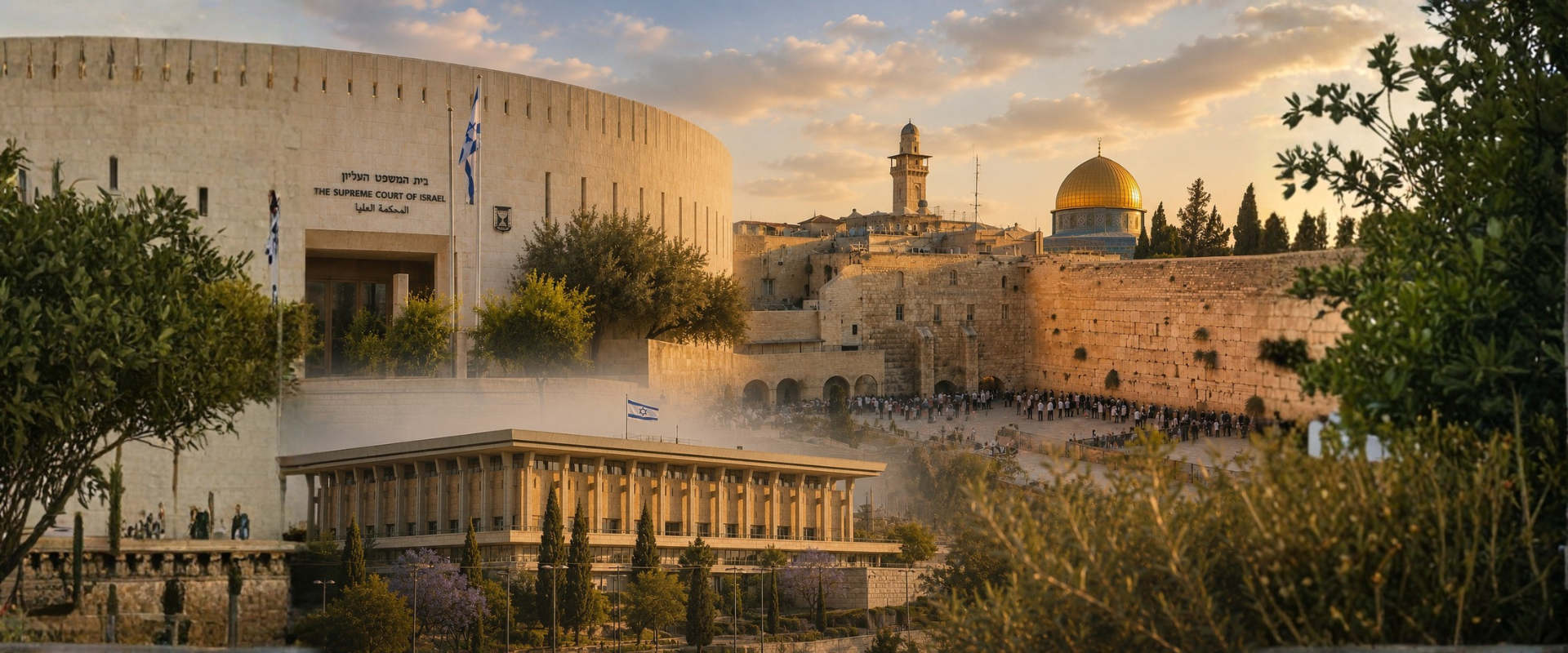
And here the different parts of the verse meet. When the police become more loyal to the person in power than to the law, and when an attempt is made to weaken the judicial system to prevent it from setting a limit on governmental power, the common ground upon which all the tribes are supposed to meet is lost.
This does not mean that every judge is always right or that every police officer is corrupt. It means that a shared society needs a system of law that does not belong to any specific tribe and is not subservient to whoever holds power at any given moment. Without a common playing field, every tribe appoints its own judges and police officers, interprets justice according to its own needs, and the people become a collection of competing power groups.
The verse begins with "Lecha" (to you), passes through "LeShivtecha" (to your tribes), but is ultimately tested by its ability to see "HaAm" (the people). The guarding begins at my gates, but it cannot end only with me or the tribe to which I belong. In order for us to continue being a people, we need judges and officers, borders and laws — but above all, we need a shared ground upon which we can still collectively seek true justice.