Parashat Vayetze

Words for Shabbat - A community blog for this week's parashah

Parashat Vayetze

– The journey of a leader and father of the nation
By Ruth Shapira
 

In the parashah Vayetze, we read about Jacob fleeing from the wrath of his brother Esau, leaving the protective home of his parents Isaac and Rebecca, and embarking on a journey fraught with difficulties and disappointments, loneliness, love, and toil, which will lead him to an independent life as an adult and head of a family.

I will focus on the beginning of the journey of change, when he is alone, exposed to the forces of nature, in physical and mental darkness:

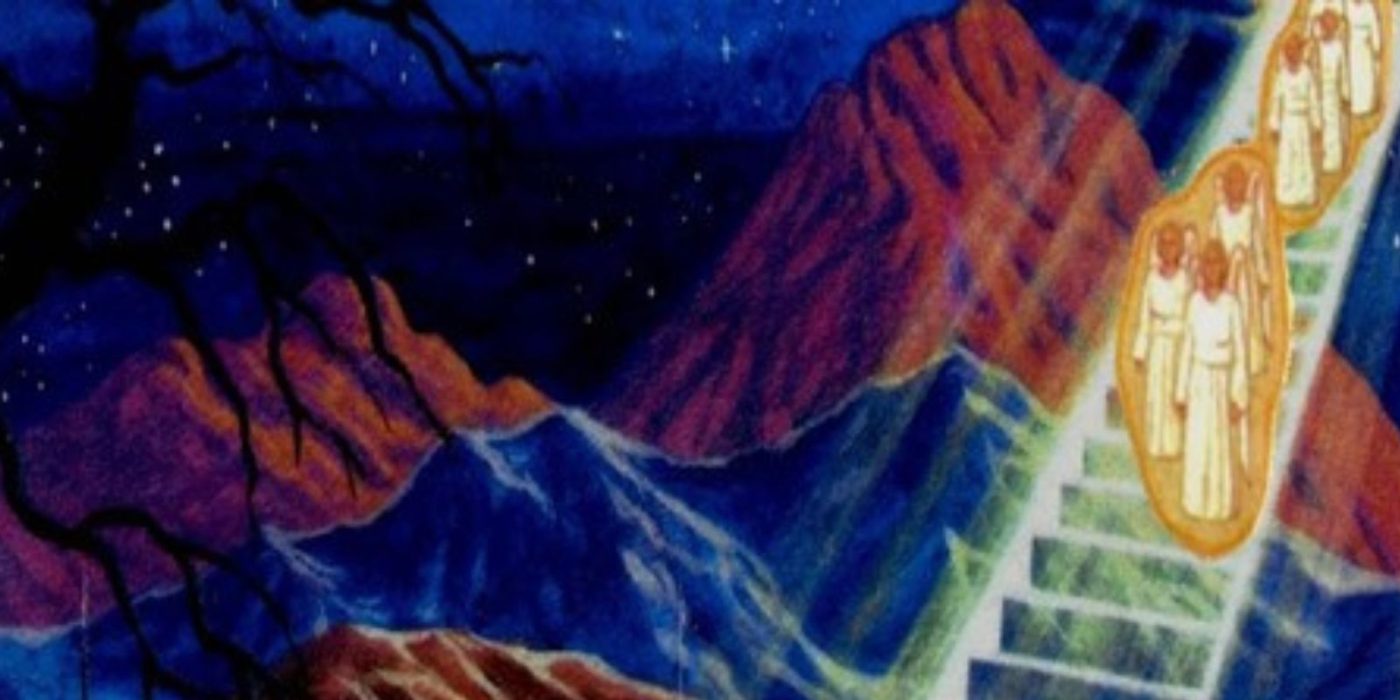
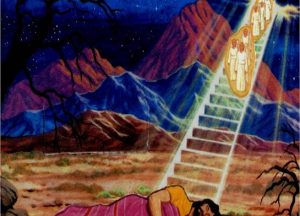
(j) And Jacob left Beersheba and went to Haran. (11) And he came to that place and spent the night there, because the sun had set. He took some of the stones from the place and put them under his head. and he lay down in that place. (12)  And he dreamed, and behold, a ladder was set up on the earth, and its top reached to heaven; and behold, the angels of God were ascending and descending on it. (13)  And behold, the Lord stood above him and said, "I am the Lord, the God of Abraham your father and the God of Isaac. The land on which you lie, I will give to you and to your descendants.  

Jacob dreams the famous dream of the ladder, through which he experiences the promise of divine providence. The angels ascending and descending symbolize the ups and downs and challenges that await him on his journey. The ladder touching the sky symbolizes man's ability to strive to improve his situation and himself and to reach higher. When he awakens, he realizes that there is a God and that he is not alone. He gathers strength and courage and continues his journey to Haran and his mother's family.

I have always asked myself: What gives us strength when we feel lonely in the face of life's circumstances? Where do we draw the strength from within ourselves to cope when we are faced with a reality that challenges us, and there is not always someone by our side who can support us?

As I was writing this, I remembered that as a child I had a feeling of divine providence that would protect me in a world where adults could not be a source of comfort and support. On the contrary, they were a source of constant anxiety, and I had to find strength within myself. I believed then that God was watching over me, that there was reward and punishment, and that those who were bad to me would be punished and those who were good, meaning me, would surely be rewarded.

This belief did not arise out of thin air, but was based, of course, on stories and legends I read and heard in my parents' home, and on my mother's absolute faith in God.

Faith is the fuel that drives us to take action, and at the age of 13, I initiated my own personal "Vayetze" story—I escaped the fate I thought awaited me if I remained in a home that was not good for me. Providence arranged for me to take the entrance exams for the Boyar boarding school in Jerusalem. I passed the exams successfully, and then I made the first significant and fateful decision of my life at the age of 13: to go to boarding school. My mother wanted me to stay at home because "good, quiet girls don't need to go to boarding school." But despite the voices that could have discouraged me, I was determined to leave, driven by a deep inner conviction that this was the right choice to save myself.

This decision presented me with challenges and personal growth, and I am grateful to that girl who, believing in the good that was to come, chose to take the leap. .

Let us return to the biblical story. The climax of the journey of transformation appears in the following passage:-:  When Jacob wrestles with the angel, he receives his new name, Israel, and with it a new identity. "Your name shall no longer be Jacob, but Israel, for you have striven with God and with men, and you have prevailed" (Genesis 32:29). Jacob receives a name that attests to his resilience and ability to survive—because Sarit fights. He succeeds in completing his journey and creating a family and continuity.

I, too, look back on the journey I have been through, on the difficulties and successes that were and still are part of it, and wish for all of us that even when we are down, we will know how to maintain our inner faith in ourselves along with our faith in God, and remember that there is a heaven. . 

Shabbat Shalom! 

Picture of רותי שפירא

Ruthie Shapira

Ruthie Shapira – Group facilitator, literature teacher, personal coach. Mother of three grown children and funny grandmother to two sweet granddaughters. Addicted to stories. Loves traveling.

Toldot

Words for Shabbat - A community blog for this week's parashah

Toldot

When our ancestors are complex, we too can accept complexity.


By Dr. Aaron (Willy) Siegel


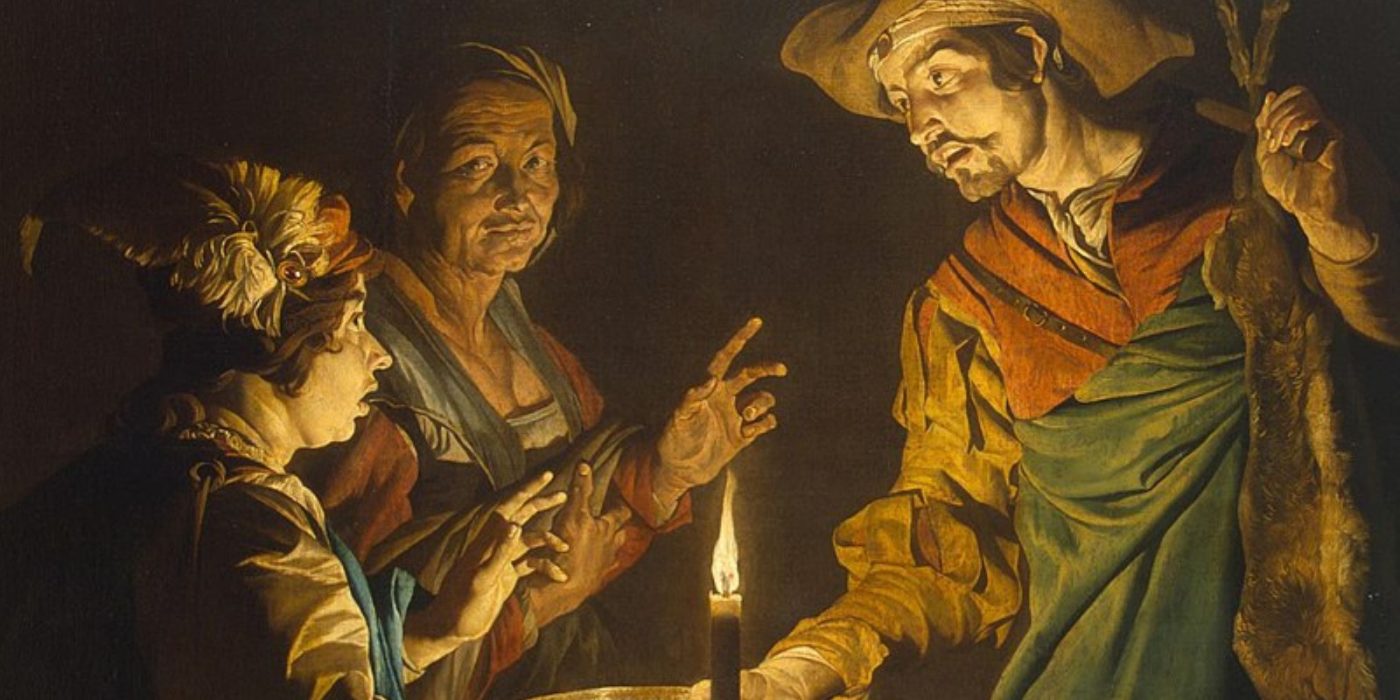
Esau and Jacob (1640) Matthias Stom, Hermitage

The Torah portion of Toldot presents a complex reality that does not correspond with the norms we would expect. How is it that Jacob deceitfully buys the birthright from Esau and then receives his father's blessing through trickery? And all this with the help of our mother Rebecca. And in general, why is the hunter considered negative and the tent dweller considered righteous?

Reading this passage from the Netherlands, while observing Israel from afar, raises questions about the way we see ourselves and others. I know it is easier to see things from the outside, but perhaps this perspective can shed some light on the matter. The Sages tend to see the world in black and white: Esau is evil and Jacob is good. But the biblical text itself is much more complex. 


Esau deeply respects his father. "Hunting in his mouth" (25:28) does not necessarily mean deceit, but rather that he brought him game to make him happy (the plain meaning of Rashi, as opposed to the interpretation that explains it as deceit). And in the portion of Vayishlach, after all of Jacob's fears, Esau "ran to meet him, embraced him, fell on his neck, kissed him, and they wept" (33:4). He was a man of action with a deep connection to nature. But he was also impulsive: "And Esau despised the birthright" (25:34) – he disregarded its spiritual significance. And when he discovered the deception: "And he cried out with a great and bitter cry" (27:34) – true and genuine pain.


Jacob – A spiritual scholar, devoted to love, stubborn and unyielding. He understands the importance of the birthright. But he also takes advantage of a moment of weakness: he buys the birthright when "Esau was weary" (25:29-34). He lies to his blind father: "I am Esau your firstborn" (27:19), and even uses the name of God to lie: 'For the Lord your God has made me appear before you" (27:20). He acts through manipulation – through his mother, through Laban, always indirectly.


Why is this important today??

Israeli society tends to see things in black and white. Each camp portrays the other in a negative light. Ultra-Orthodox Jews see secular Jews as a threat to Judaism, and secular Jews see the ultra-Orthodox as religious coercion. The right wing sees the left wing as traitors, and the left wing sees the right wing as fascists. Those who advocate separation of powers see others as a danger to democracy, and those who prefer majority rule see others as a detached elite. Some see military service as a supreme value, while others see Torah study as the true contribution. Jewish and Arab citizens of Israel see each other as a threat rather than a partnership.

Each side exaggerates the negative behaviors of the other and ignores the good in them. These tensions create internal strife within our society.

But the story teaches us that reality is more complex. Esau himself, whom Jacob feared so much and was sure would want revenge, ultimately ran to embrace him. If our ancestors were not black and white, perhaps the "other" in our society is not black and white either.


The ultra-Orthodox Jew who does not serve in the army may contribute in other ways. The secular Jew who does not observe Shabbat may be very charitable. The right-winger who advocates sovereignty may truly care about security. The left-winger who advocates compromise may truly want peace. Everyone has their own values, as well as legitimate concerns.


And just as Jacob and Esau learned to embrace each other despite everything, perhaps we too can learn to see the complexity of the other. Not necessarily to agree, but to see that on the other side there are also people with good intentions, with genuine concerns, with a contribution to make to the nation.


And when we learn to accept complexity internally, perhaps we can also extend this outward—toward our neighbors. To understand that there, too, reality is not always black and white.

This story reminds us that the world is not black and white. That righteous people are not perfect, and wicked people are not one-dimensional. And that perhaps, if we stop for a moment to see only the bad in others and start looking for the good as well—even in those who think differently—we can move a little closer to inner peace.


Perhaps then we will become a more balanced society, one that knows how to embrace complexity.

Picture of ד"ר אהרן (Willy) סיגל

Dr. Aharon (Willy) Siegel

Dr. Aharon (Willy) Siegel was born in Amsterdam, immigrated to Israel, was educated there, and served in the Israeli army. In recent years, he worked for Israel Railways and was an active member of an Israeli synagogue. He now lives with his family in the Netherlands, where he misses Israel and reflects on the place of Israel and Judaism in the world.

Chayey Sarah

Words for Shabbat - A community blog for this week's parashah

Chayey Sarah

On investigative committees, marriage transactions, and women's rights

By Ofra Palmer Granot
 

At the heart of the story, we see how matchmaking worked in the ancient world, which gives us a glimpse into the social and economic systems that were common back then and might still be around today. We'll get to that in a minute...

The story starts with Sarah's death., Abraham's wife, at the age of 127, in Kiryat Arba, which is Hebron in the land of Canaan. Abraham purchases land and Sarah is buried in the Cave of Machpelah. Immediately afterwards, Abraham's servant is sent to Aram Naharaim to find a wife for their son Isaac.

Abraham's servant receives explicit instructions and sets out on his journey. The parashah repeats the story in variations three times:

The first time he received the task: Abraham swears his servant: "Go to my country and my birthplace, and take a wife for my son Isaac."

Second, the text describes the story itself: "And the servant took ten camels from his master's camels and went, and allhis master's goods in his hand, and he arose and went to Aram Naharaim, to the city of Nahor."  

Then again, the servant describes to the family of the girl chosen for marriage the task he has been given: "And my master made me swear, saying, "You shall nottake a wife for my son from the daughters of the Canaanites, among whom I dwell. If you do not go to my father's house and my family, and take a wife for my son."

Finally, the servant returns to his master with the task completed and tells Isaac all that has happened, like a debriefing report. "And the servant told Isaac all the things that he had done.".

Why is the repeated description necessary? This may be to emphasize Abraham's intention to choose a wife for his son from among his own people, or to describe Abraham's wealth and thus the profitability of the proposed deal for the family of the girl intended for marriage.

It seems to me that the repetition in the description of events occurs in order to validate complex processes and remind us to revisit and examine what the mission was and what actually happened. Documenting significant events, investigating them, and holding those responsible to account are very important steps in our public life today. We must demand this.

===
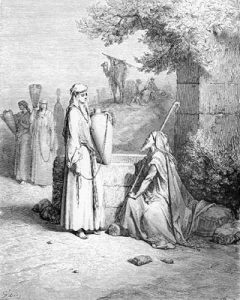
How romantic can a scene be that includes a desert, a spring, a beautiful girl, a caravan of camels, a water jug, and lots of gold and jewelry?

Poems were written, paintings, engravings, and photographs depicted this human, romantic, and even erotic scene. But things are not as innocent as they seem at first glance.

Abraham's servant arrives in Aram Naharaim, in the city of Nahor, and sees the daughters of the city's men going down to the spring carrying jugs.

What value does he see in the girl that makes him run to her? How is she measured? What are the criteria for a good and worthy woman?

The girl who caught the slave's eye is beautiful and a virgin. She is quick, knows her job, is kind and generous, volunteers to water the camels, and, just as importantly, comes from a respectable and wealthy family.

And here the trade begins: after the slave examines her behavior, which is to show kindness to strangers, hastening to give him and his camels water to drink, he rewards her with a nose ring and gold jewelry. Rebecca's brother, Laban, hears about this, runs to the spring to see what is going on, finds out who the messenger is, and invites him to their home.

After the servant describes his origins, his mission, and the sequence of events, Laban and his father Bethuel agree to give Rebecca to Isaac. Abraham's servant gives a reward "And the servant took outsilver and gold vessels and clothing, and gave them to Rebekah; and he gave precious gifts to her brother and her mother."

The surprising twist, like a feminist one, comes later. Rebecca is apparently very young. Her brother Laban and her mother Milcah are debating whether to send her away immediately or to wait. They suggest calling Rebecca and asking her if she would agree to travel far away with the messenger. And they said, "Let us call the girl and ask her." 58 They called Rebekah and said to her, "Will you go with this man?" And she said, "I will go."

Who is the feminist here? The family members or Rebecca herself?

It is not entirely clear how much freedom the young girl really has to decide her own fate. She received a nose ring and bracelets, silverware, gold, and clothes, and saw her mother and brothers receiving gifts... Perhaps she felt obligated, or perhaps she even fell in love with the slave himself.

In any case, it seems that this step taken by the family of Bethuel ben Nahor to ask the girl for her consent has resulted in women having the right to choose their husbands even today, thousands of years later, in our Hebrew culture.

And that, my friends, is no small thing, then or now.

Picture of עפרה פלמר גרנות

Ofra Palmer Granot

Ofra Palmer Granot, Volunteer Coordinator at the Tel Aviv-Jaffa Museum.

Vayra

Words for Shabbat - A community blog for this week's parashah

Vayra

Fear of God between faith and fear

By Amir Shafat
 

When I wear a kippah, I show the world that I believe and remind myself that I fear God. This week's Torah portion contains two completely different fears of God.


The parasha opens with the words "And the Lord appeared to him by the oaks of Mamre…' from the word ra’ya (seeing). And Abraham sees and acts "He lifted up his eyes to him and saw…and he saw and ran…" Scripture accustoms us to interpret the root y.r.a. as a sensory experience of sight about twelve times in the parasha. But when Sarah laughs in disbelief at the angels" message, and then denies it, she says "I did not laugh, for I feared…" The internal contradiction in the sentence is blatant because we know that Sarah laughed and the denial contradicts the declaration of fear of God. A person who fears God would not declare a lie before the angels of God.


But what does fear (Yira) mean? In modern Hebrew, it means fear. Is a believer a person a person who fears God? We have all experienced leaders, commanders, and administrators who used fear to establish their control. If I fear the leader or respect him, in many cases my behavior towards the leader is similar, at least according to external signs. In the case of Sodom and Gomorrah, there is good reason for fear. The cities were destroyed and their inhabitants died because "their sin was great and very heavy." But besides fear, the chapter goes into depth by presenting two types of faith: faith based on benefit and fear of God that does not depend on anything.


In the Bible, a God-fearing person is a person of faith. The story of Vayyar presents us with two types of faith (fear of God). When Abraham arrives in Gerar, he does not present Sarah as his wife, but as his sister. Abraham explains to Abimelech, the king of Gerar, that "there is no fear of God in this place." According to the explanation to Abimelech, fear of God is a social system that enables control, prevention of suffering, and joint effort for the common good. The fear of God is a human means of establishing government, correcting the world, and improving the fate of man. In the extreme case, God is needed to create fear and awe, a fear of punishment for the benefit of social order.


In contrast, after Abraham passed the test of aqeedah, we read, "Now I know that you fear God." This is a different faith because such faith is of no benefit to a person, neither as an individual nor as a society. Moreover, faith breaks promises (I will multiply your seed), breaks social conventions (human sacrifice), and is contrary to human nature (loving our child). Abraham, the father of his son, as a spouse, as part of a human society, completely failed the test of aqeedah, and thus passed the test of faith and fear of God. We saw a few verses ago Abraham's ability to argue with God, to answer Him, to bargain with Him about the number of righteous people needed to save Sodom and Gomorrah (he reduced God's price from fifty to ten). But in the test of aqeedah, Abraham's devotion indicates a faith that is not based on fear and is of no benefit to the individual or society.


As a Jew, I wear a kippah (yarmulke, fear of the kingdom in Yiddish), as an external sign of fear of God and a reminder to myself. I move in the range between the fear of Elimelech and the fear of Abraham. I oppose with every fiber of my being the religious establishment's use of faith and fear of God for social exploitation, but I want to pray together with my people. I strive to reach a pure faith like Abraham's, but I am happy that I will never succeed. To me, such a faith is a very lonely place ("here I am") and devoid of morality. I live in the tension between fear-based faith and pure faith. As my late grandfather, David Stockfish, said with a half-smile, "It is not easy to be a Jew.".


Picture of אמיר שפט

Amir Shaft

Amir Shaft is a father of two teenagers, lives in the West of Ireland, is a professor of physiology, a cyclist, a Jewish believer, and a lover of people.

Parashat Lech Lecha

Words for Shabbat - A community blog for this week's parashah

Parashat Lech Lecha

A journey of choice, identity, and alliance

By Brigitte Bigard
 

I was asked a few weeks ago to write a “dvar Torah” on the parasha Lech Lecha and I think this is from HaChem for two reasons : 1) This parasha is, I think, the one my eldest son read for his Bar-Mitzvah, 2) This is a very meaningfull parashah for me because I made aliyah 17 years ago and the two words “Lech Lecha” echoe in my heart.

The command that God commands Abram at the beginning of the parsha is made up of three parts: “from your land,” “from your native land,” and “from your father’s house.” At first glance, the meaning of “land” and “native land” may seem similar, but from a study of the previous parsha, we can understand the difference: Terah, Abram’s father, set out from Ur of the Chaldeans on his way to Canaan with his family, but stopped along the way and settled in Haran. Hence, “your land” refers to Haran – Abram’s current place of residence, and “your native land” refers to Ur of the Chaldeans – the place where he was born.

The injunction Avram receives contains three different terms and it’s important to understand each of them. G-d says : Go from your land, from your birth’s place and from your father’s house. At first sight it’s difficult to understand the difference between the land and the birthplace. The answer is in the precedent parasha : At one point (and we have no explanation why) Avram’s father, Terach, decided to go to Cana’an and left Ur Kasdim . But he stopped on his way to Cana’an and settled down in Haran with Avram and Avram’s wife, Saraï, and Haran’s son, Lot after Haran died. Haran was Avram’s brother. Another brother decided to stay in Ur Kasdim. And now we get to our Parashah : “your land” is Haran and “your birth’s place” is Ur Kasdim. The order to get out from “your father’s house” is more difficult to understand because normally the family would stay in the same place. Howcome Avram is told to leave his old father who has lost one of his sons ? It might be considered as cruel, but in fact if Avram is to fulfill his mission, he has to quit his ancestors and the countries where he used to live. He has to create a new path, a new life, a new “brit” and he has to get rid of the past. If I may relate this to my personal life I can testify that it is quite difficult, when you’re a grown up to leave and create something else in your life. You have to look forward and you cannot maintain bounds with the past. You have to build a separation between your new life and what you did in the past and this is why, maybe, G-d asked Avram to leave the past behind him and to go to where He would tell him. G-d is testing Avram’s capacity to believe in Him and to obey eventhough he has to go to a place he doesn’t know . As we know G-d will test Avram later on when He asked him to kill Itzhak. As there are a number of very interesting subjects in this parasha, I choose to add a few comments on the last subjects, namely the circumcision and the change of names. Once again HaChem gives Avram (who became Avraham) an order impossible to understand… HaChem wants from Avraham an unquestioning obedience. And not only has Abraham to circumcise himself but his sons and all the male inhabitants of his house! God explains that this will be a binding sign between Adonaï on one hand and Avraham and his descendants on the other hand. Just before this injunction, God promised to Avraham to give him a very large lineage and the possession of the country he settled in, namely Canaan. What is the relation between the circumcision and the possession of Canaan ? There is no explanation in the Tanah, so let’s elaborate: God chooses a man, Avram. He asks him to quit his fatherland, his family and to settle down in a foreign country. And then he promises him to give him and his descendants this country. At this time Avram has a son named Ismael but he is the son of a servant, Agar. And God means that Saraï will become a mother and her identity will change : her name will be Sarah when she becomes a mother. And Avram’s name was also changed and became Avraham. Each one of this founding couple got a “he” in their name. We know that this letter is very important : it appears twice in the name of God and it gives the couple a sacred meaning : Both Avraham and Sarah are to be devoted to God and God’s reward is enormous : a descendance and a country ! So we have two distinctive signs of the alliance between God and this couple : a physical sign for the man, namely the circumcision and for both of them a sacred letter added to their name: their identity has changed ! They have to behave the way God asks them. They have to carry the responsibility of creating a Nation devoted to God. One could ask : Why is there no distinctive physical sign between God and Sarah ? My opinion is that to become a mother is enough and Sarah knows that this is a miracle: she is too old after the human rules to become pregnant…That’s why in the future of Am Israel women do not need another sign than to become mother in order to be related to God. Am Israel Haï

From my own experience of immigration, I can attest to how difficult it is, as an adult, to leave and build a new life. This process requires looking ahead and a certain renunciation of what was in the past. Perhaps this was God’s message to Abraham: to be the “father of the nation,” he must free himself from old meanings and step into an unknown future with full faith.

Later in the parsha, God commands Abraham to perform the commandment of circumcision. Here too, it is a commandment that does not seem logical, and requires absolute obedience. Circumcision constitutes a physical and permanent sign of the covenant between Abraham and his seed and his God. Once again, God gives Abraham a commandment that is difficult to understand from a human perspective—unquestioning obedience, not only regarding himself but also regarding his sons and all the men in his household.

Before this command, God promises Abraham two foundational promises: a land – the land of Canaan where he lives – and a great seed. However, at this point Abraham only has one son, Ishmael, the son of Hagar. God announces that Sarai, his wife, will bear him a son, and her name will be changed to Sarah. Abram's name is also changed to Abraham. The letter H is added to both – a letter of high spiritual significance, which appears twice in the name of God. The change of name signifies a change of identity and a new mission: a couple who are committed to raising up a people dedicated to their God.

Thus, two different and complementary signs of the covenant are established: one – physical, in Abraham and his male offspring; and the other – identity, which appears in the change of names Abraham and Sarah. They are committed from now on to bear the responsibility of creating a people dedicated to God – this is their new mission.

And here a natural question arises: Why is there no physical sign of covenant with Sarah, as was given to Abraham? In my opinion, the very fact that Sarah becomes a mother is in itself a divine miracle—and also a profound sign of covenant. Sarah knows very well that at her age it is not natural to give birth; therefore, for women, the very ability to be mothers is the sign of a connection with God. There is no need for an additional sign.

These two components – embarking on a new path and signing a covenant – shape the initial Jewish identity: belonging to the land and belonging to the faith. The journey of Abraham and Sarah is a process of personal and national identity that is realized in future generations, and continues to exist since then to this day.

Am israel Hai

Picture of בריג'יט ביגאר

Brigitte Bigard

Brigitte Bigard divides her life between Israel and Paris-Geneva, and is involved in distributing the anthology "Seven" - which she translated into French. She leads an initiative to write poetry for teenagers affected by the war. A devoted grandmother, a lover of art and classical music, and a frequent reader in French, English and Hebrew.

Noah's Parsha

Words for Shabbat - A community blog for this week's parashah

Noah's Parsha

On Activism – Between Noah and Abraham

By Ronen Koehler
 
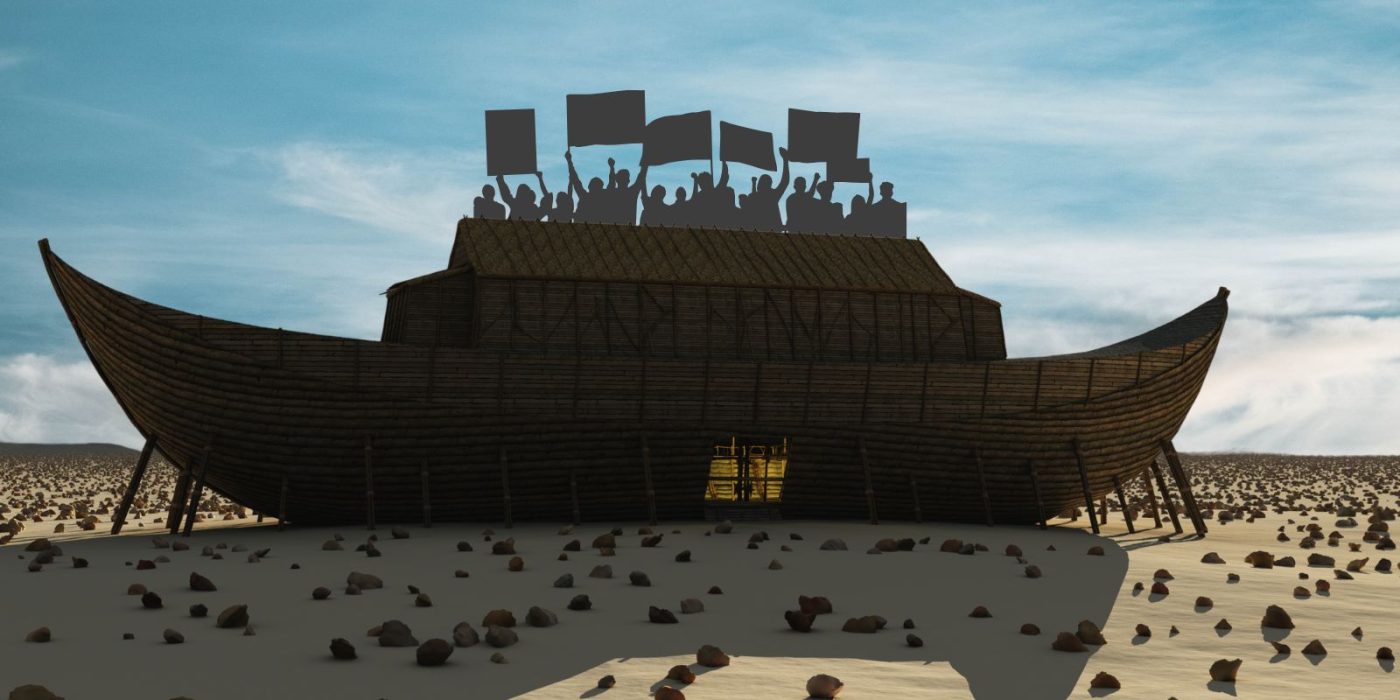
Sometimes I think how easy it was to be comfortable. To be righteous in your own skin, to watch society be destroyed, to build an ark, to shut yourself away, to survive the storm – and wait for it to pass, but it really will pass (so that we don't even get our feet wet when we get off the ship).
 

But I'm not comfortable. And I don't want to be.

The story of Noah tells of a society that fell apart from within. “And the earth was corrupt before God, and the earth was filled with violence” – an ancient phrase that sometimes feels as if it were written for our day. It was not personal religious sin that destroyed that world, but corruption, violence, and the loss of mutual responsibility. And Noah, the righteous man who builds an ark, saves himself, but does not try to save his generation.

I see this as one of the great lessons of this affair: survival alone is not a mission.
There comes a moment when you have to step out of the box – out of comfort, out of fear, out of silence – and start rebuilding. You have to take risks in those moments. Not send out crows or doves all the time to make sure everything is safe out there.


And after the flood, a different humanity is born, no longer uniform, speaking different languages. The Tower of Babel falls because humans try to impose uniformity instead of discovering the beauty of diversity. It is precisely this plurality – of opinions, of beliefs, of cultures – that can truly save us. Only then does the new call sound: “Go, go.”.
In my opinion, this is the moment when responsibility is born.


Avraham is the first activist – a person who doesn't wait for operating instructions and is content with a general "go, go." He walks, argues, acts, believes that it can be fixed.

From the seemingly safe ark and the passive Noah, to the unknown path and Abraham the activist, this is the transition that each of us is called to today.
Not to be saved but to save, and not to protect ourselves and lock ourselves in a box, but to build a more just and better world together.


Picture of רונן קלר

Ronen Koehler

Ronen Keller is an organizational consultant, social activist, one of the leaders of "Brothers in Arms," and chairman of an Israeli activist center.

Bereshit

Words for Shabbat - A community blog for this week's parashah

Bereshit


Bereshit

By Dr. Esti Doron
 
I have debated a lot about what to write about in the Book of Genesis. A chapter that contains five stories (the creation of the world, the creation of Adam and Eve, the Garden of Eden, Cain and Abel, and the association of angels with the daughters of man) on each of which, individually, one could write entire pages, and each story evokes different emotions, countless questions and interpretations. Dozens of paintings have been painted about each of the stories, most of which came mainly from Christian culture, and many poems have been written, both in world culture and in contemporary Israeli culture. 
 

I decided to share a few points I've been thinking about, which are very relevant to these days.


1. Parashat Bereishit begins the Torah reading cycle immediately after the conclusion of the last parasha in the Pentateuch. The parasha is adjacent to the end of the month of Selichot and the High Holy Days, Rosh Hashanah, the Ten Days of Repentance, and Yom Kippur. There is a connection between the processes of repentance, atonement, and correction and the beginning from Genesis. And what is the beginning from Genesis? To remember that we were created in the image of God, that we received the world to serve and preserve, and that we must correct everything that needs correction in the world. This connects to the last two years in particular, with our desire to rebuild Israeli society, to rise from the great rift of the October 7 massacre, and to begin building a more just and equitable society here.
 
2. The Torah emphasizes that it is not good for man to be alone. The creation of woman alleviates man's loneliness. And the LORD God said, It is not good that the man should be alone; I will make him a helper suitable for him.: But not only a woman helps loneliness, but a community, a sense of togetherness. We live in a time when loneliness is more present than ever, and psychologists claim that loneliness is the silent plague of our century. (The reasons that led to this are not new; the breakdown of the clan structure and the breakdown of communities, the breakdown of the ancient family structure and the introduction of technology). Another place where loneliness could be present is in the struggle of the families of the kidnapped. One of the reasons I make sure to participate in the demonstrations in "Kachar Hatofim" is related to this fact. "You are not alone! We are with you" I shout at the top of my voice every Saturday. You are not alone. There is a community around you. People see you! We strengthen you. We are the "help" against you!
 
3. The story of Cain and Abel is the story of the first murder in the Bible. And not just any murder – but a murder within the family between two brothers. The Torah does not specify the reasons for the murder. And Cain said to his brother Abel, and they were in the field; and Cain rose up against his brother Abel and killed him. This story is supposed to be a warning sign of what can happen when brothers are jealous and do not get along with each other. But suddenly I feel that it also normalizes the fact that such a murder can happen. And if between brothers it is normative, how much more so between people of the same nation, who are currently in a deep polarization and the extremization of all emotions and hatreds. How do we turn this sign of Cain, this warning, into the greatest threat to the integrity of our society? About our ability not to reach a civil war?
 
4. We must strive to be moral. We were created "in the image of God." The strange story of the connection between the sons of God and the daughters of man proves how difficult it is to work on our virtues, to be moral all the time, to forget about the impulses of greed, envy, revenge, and competition. Even the angels sin. So we as humans are all the more so. This connects me to a place that emphasizes the Judaism of kindness and the Judaism between man and his neighbor. This connects me to the Psalm of Psalms 34:13-15. Who is the man who desires life? His tongue is created from evil and his lips speak deceit, he turns away from evil and does good, seeks peace and pursues it. In my opinion, this is true Judaism. Judaism between man and his neighbor. Judaism that emphasizes the values of morality and kindness. This is the Judaism that I choose. 
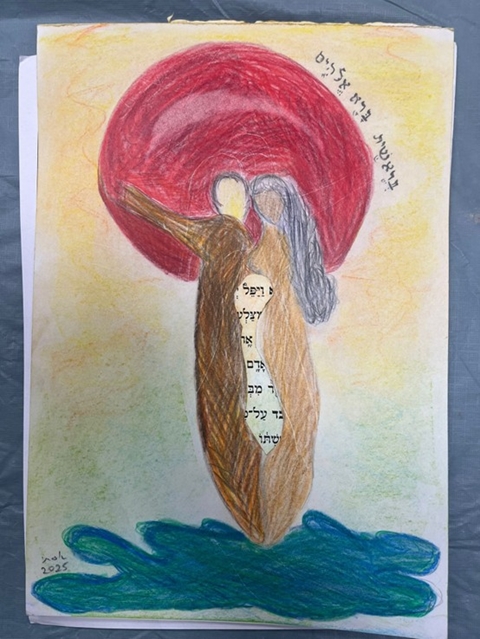
5. From France, a painting of mine, which began from observing a tree trunk, where I found an embracing "couple" among the roots. From the tree's roots developed an entire creation of man and woman, earth and sky, and verses from the book of Genesis. I am not a painter, but it is interesting that this creation was born during the month of Elul and before Rosh Hashanah. 
6. The return of the twenty living abductees on Monday, the eve of Simchat Torah 5775, symbolizes to me more than anything the cyclicality and circularity of our lives. On the eve of Simchat Torah 5774, it all began, and on the eve of Simchat Torah 5775, one chapter related to the living abductees ended. And this morning in the synagogue, we joyfully read the book of Genesis. Most of all, the lines resonate with me: "To rise tomorrow morning, with a new song in my heart, to sing it with strength, to sing it with pain, to hear flutes in the free spirit and to begin from the beginning." Let us hope that we too, as a nation, will rise, grow, and begin our great correction as a society, we will begin from the beginning.
Picture of ד"ר אסתי דורון

Dr. Esti Doron

Esti Doron is a Doctor of Education and is involved in teacher training, evaluating educational projects, and fostering educational leadership. She is married, a mother of 3, and a loving grandmother to a grandson.