Weekly musical Kabbalat Shabbat

Kabbalat Shabbat is a weekly event.

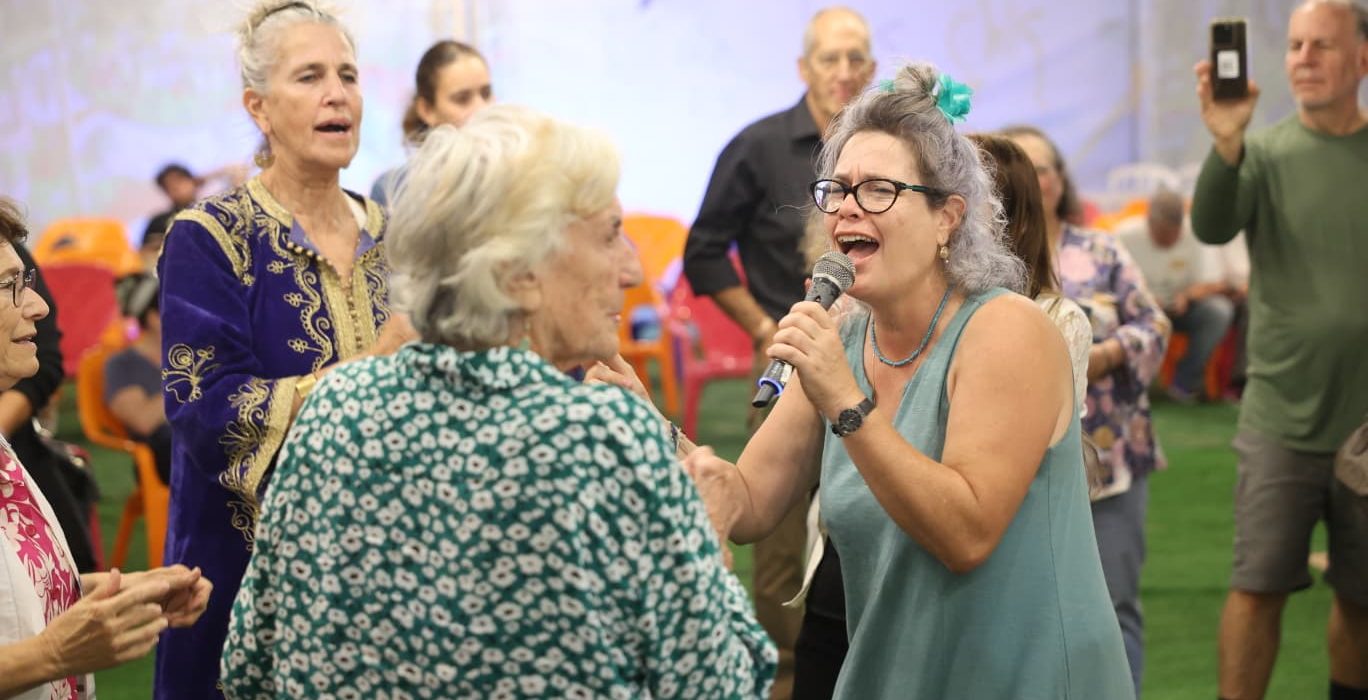
Musical Kabbalat Shabbat at Beit Shalom Aleichem every Friday

Welcoming Shabbat together, with music, singing, Israeli prayer, and a community atmosphere!!
You are invited to take a breath before Shabbat, and join a Israeli, Tel Avivian communal prayer that blends the old with the new, the Jewish with the Israeli, and the personal with the communal. Suitable for all ages!!

With Rabbi Esteban Gottfried, Didi Dror, the acclaimed singer Atalia Levi, and musician Matthias Shlomo, and other musicians.

We meet every Friday at 6:30 PM at Beit Shalom Aleichem, Berkovich 2, Tel Aviv.
You are invited to bring a food or drink item for the Kiddush following Kabbalat Shabbat.

Admission is free with advance registration. Leave your details.

Parashat Tazria-Metzora

Words for Shabbat - A community blog for this week's parashah

Parashat Tazria-Metzora

Between proximity and distance

 
By Dr. Esti Doron
 

The parshiyot (Torah portions) of Tazria-Metzora deal with the laws of ritual impurity and purity, as well as various afflictions that befall a person: in their home, their garments, and their skin.


Already at the beginning of the portion, we encounter the laws of Niddah related to childbirth: the difference between the birth of a son and the birth of a daughter in terms of days of impurity and purification and the waiting period for marital relations. When a son is born, one counts seven days of impurity and another thirty-three. When a daughter is born, one counts fourteen days of impurity and another sixty-six before purification.


Precisely at the moment of creating new life, at the moment of deep physical intimacy, separation also appears. It is as if the Torah seeks to remind us that intimacy is not a given continuum, but a delicate movement of coming closer and moving away, of longing and renewal. In this context, I found it appropriate to include Rabbi Elhanan Nir's poem "After Birth," which deals with longing for a woman and for marital relations.


After childbirth/ Elhanan Nir

For months

And I don't know how to tell you

As is understood according to Halakha, etc.

But just so you know

It's already been months.

And all my bones shall say

But they don't know how, according to Halakha, to tell you

That we have a new baby, thank God.,

I am not saying that I

No

Waiting for you and so on.'


Subsequently, the affliction moves into the realm of plagues: spots on the walls of the house, blemishes on clothes, and finally, plagues on human skin. The plagues on the house and clothing are sometimes treated with external means: cleaning, removal, and even destruction, but when the plague appears on human skin, it already carries a deeper significance.


The Sages linked leprosy to evil speech; to the damage of relationships between people. One who banishes his fellow from the camp with his words finds himself banished from the camp. The isolation becomes "a measure for a measure": the person sits alone, outside the camp, and reflects. But this isolation is not just punishment. It is also a pause. A space where one can recognize that something has gone out of balance and begin to re-evaluate. 


The word "quarantine" itself evokes a heavy, almost suffocating feeling in me, and one can't help but remember the period of Corona, when we all experienced, each in our own way, this distance. I especially remember the Passover Seder night when we were forced to sit by ourselves (or hold the Seder on Zoom) and couldn't visit or host. I remember bringing my elderly mother holiday supplies and leaving them for her by the door, for fear I might infect her with Corona, as I used to go out and also work with other people in the office. I will not forget the moment I lit holiday candles and simply cried, knowing my mother was sitting alone in her home, not celebrating Seder, even though she could have because she had all the supplies, and going to bed early so as not to feel the absence of the holiday. Quarantine is a harsh punishment, not only physical but also psychological and existential.


And the question that arises before me in light of our parsha is not just why isolation is required – but what happens after it, how do we return? How do we come back to the community, to contact, to communality, after we have been “outside the camp”? And does the community truly know how to welcome back, or does it continue to see in the person the contagion he once had... I would like to offer another angle to look at isolation. Not just as a punishment, but as an opportunity to admit weakness, to admit that something has happened to me, that I am not precise, that I need a pause. To take a time out, to observe, to recalculate the route.


In days when it seems we are all a bit “leprous,” a bit wounded, a bit imperfect, carrying with us the traces of such a complex period – isolation also contains a quiet call to turn inward. And perhaps here, the beginning of the portion connects to its end: as in the laws of intimacy after childbirth, both there and here, the path back to closeness is not immediate. It requires time, a process, and sometimes even a ritual: immersion in water, a marked transition, a moment of recognition. True closeness, it seems, is not just being together, but knowing how to traverse the distance and return from it. Perhaps we can take a dual message from the Tazria-Metzora portions: we must learn to pause, to listen, to make room for what has been fractured, but no less importantly, to be a community that knows how to welcome people back with grace. A community that not only guards its boundaries but also knows how to heal. I hope we will be that community.

Shabbat Shalom!


Picture of ד"ר אסתי דורון

Dr. Esti Doron

Esti Doron is a Doctor of Education who specializes in teacher training, evaluation of educational projects, and fostering educational leadership. She is married, a mother of three, and a loving grandmother to two grandchildren.

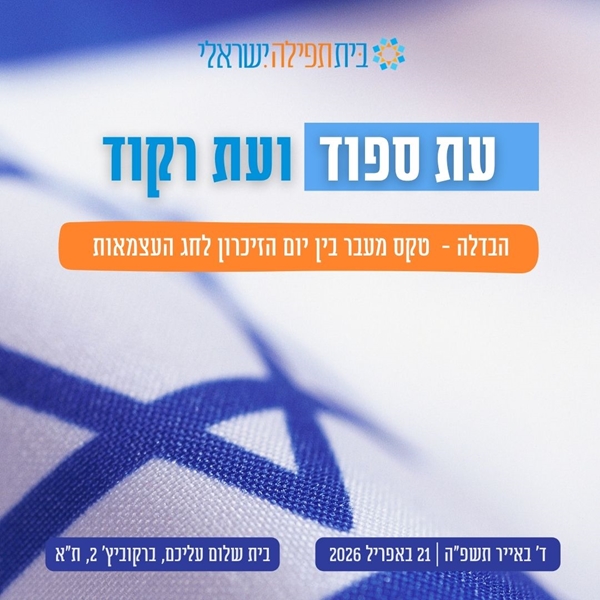
Distinction between Memorial Day and Independence Day 2026

Havdalah
A ceremony of transition between Memorial Day and Independence Day

A time to mourn and a time to dance

Havdalah - a ceremony of transition between Memorial Day and Independence Day

A time to mourn and a time to dance
 
 
Difficult days are passing us by, and the moment of transition between the day of mourning and the day of joy is especially difficult. This is a uniquely Israeli trait, which found expression in the Havdalah – a time to weep and a time to heal. This year, the transition is even more difficult and the current context undermines many of the sentences that make sense throughout the holiday.
 

However, this moment calls for fulfillment, for words, and for togetherness.

About two decades ago, a small group of people who founded Israeli house of prayer in Tel Aviv It came together to try to provide a response to the ritual need that the juxtaposition of these days invites us to. The proposal received was to dwell precisely on this gap of time, between mourning and joy, and fill it with a ceremony that combines Jewish and Israeli materials and form. A ceremony of Havdalah. A Havdalah between Memorial Day and Independence Day.
The distinction between Memorial Day and Independence Day is built from ancient and new, traditional and contemporary creative materials. Through poetry, prayer excerpts, hymns, reflections, and Israeli songs, we manage to create a gradual emotional transition between the polar states of sorrow and joy, and to observe the human capacity to move between changing mental states using different layers of the Hebrew language. At the center of the ceremony is a free variation of the Havdalah blessing between Shabbat and weekdays, adapted to the unique transition between the sanctity of Memorial Day and the sanctity of Independence Day.

This year, more than ever, it is essential that we go through this moment together. Beit Tefilah Israeli invites the general public to a joint Havdalah with Israeli music, prayer songs, and soul healing.

 
The Havdalah ceremony will take place on Wednesday, April 21st. We will meet at 6:00 PM. Arriving early is recommended.
Event location: Beit Shalom Aleichem – Berkovich 2, Tel Aviv
 
Admission is free, subject to availability. Register here!
 

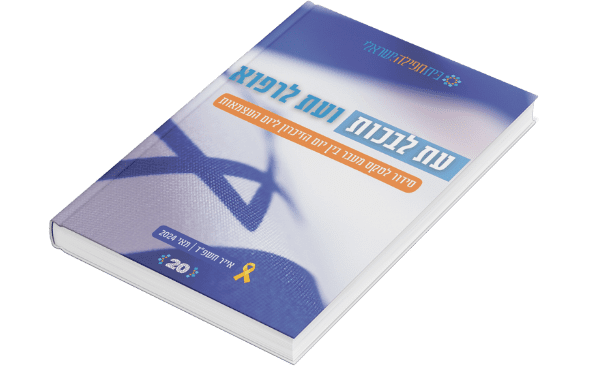
Here you can download the Havdalah order for 5786.

Our Memory – A Sharing Circle on Memorial Day Evening

Holocaust Remembrance Day gathering and testimonies

Our Memory - A Sharing Circle on Memorial Day Evening

Monday 4.26.20 at 8:00 PM at "Bipnuchu" - Itamar Ben Avi 9 Tel Aviv

Our Memory: Community Memory Spaces You are invited to "Our Memory." A community gathering for sharing on Memorial Day evening, which we will hold on Monday, April 26th, at "Befanechu" - 9 Itamar Ben Avi Street, at 8:00 PM. "Our Memory" initiates a request to create 78 parallel events across Israel, taking place after the state ceremonies on Memorial Day eve for fallen soldiers of Israel's wars. The initiative seeks to create community, intimate, and small spaces that allow participants to share stories, memories, and thoughts in a close conversation. The exact mix and content of each meeting are flexible and determined according to the spirit of the event's leaders – this is a basic characteristic that allows each community to imbue it with the appropriate content. At the heart of the meetings is the desire to create personal and open dialogue, which builds collective memory from individual memory. From the understanding that sharing personal memory lays the foundation for a shared future. The encounter between different stories surrounding pain and the Israeli narrative allows for deep, unhindered connection, strengthening our social fabric.

House of Study: Rituals, This Time - A Divorce Ceremony

Holocaust Remembrance Day gathering and testimonies

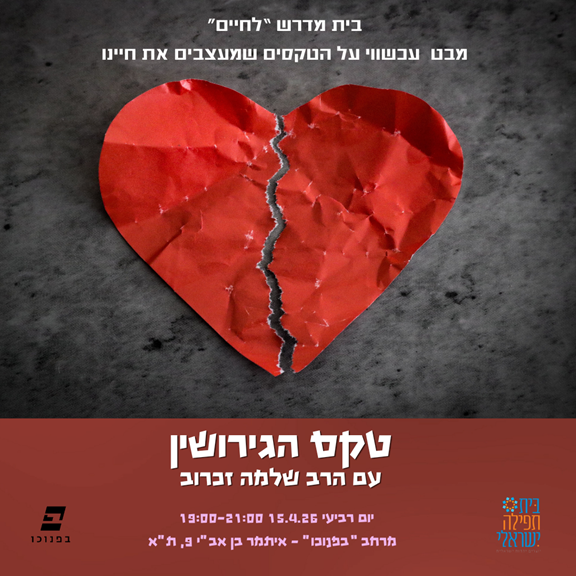
Study Hall for Ceremonies: 15.4 - Divorce Ceremony

15.4.26 19:00-21:00 On the divorce ceremony with Rabbi Shlomo Zacharov

"Rabbi Akiva taught: If a man and a woman merit it, the Divine Presence rests between them. If they do not merit it, fire consumes them. (Babylonian Talmud, Sotah 17a) How can Rabbi Akiva's words be reconciled with a world where one in three couples separates or divorces? And how can one "separate forces" according to Judaism? In this session, we will meet with Rabbi Shlomo Zacharoff, who serves, among other roles, as the Chairman of the Halachic Committee of the "Knesset Harabanim" of the Masorti Movement in Israel and manages its Rabbinical Court for Divorce. Together with Rabbi Shlomo, we will delve into the Jewish divorce ceremony and learn about its origins, the course of the ceremony, the content of the Get (divorce document), how it is written, what it obligates and what it permits, and much more. A session of learning, conversation, and sharing. Wednesday | April 26, 2020 | 7:00 PM–9:00 PM "Befanuchu" Space 9 Itamar Ben-Avi Street, Tel Aviv.

Shabbat Chol HaMoed Pesach

Words for Shabbat - A community blog for this week's parashah

Shabbat Chol HaMoed Pesach

On the connection between the Song of Songs and Passover

 
From Esteban Gottfried
 

On Shabbat Chol HaMoed Pesach, it is customary to read the Song of Songs. The connection is less obvious than the Book of Esther on Purim, and the custom is relatively recent – (it first appeared in the Vitry Machzor (Rabbeinu Simcha, a student of Rashi) – mid-12th century) – nevertheless, let us focus on this connection.


Among all the books of the Bible, Song of Songs is perhaps the most surprising. A book in which it is not at all clear if there is a single word about God. A book over which the Sages argued whether it sanctifies the hands – meaning, whether it is holy enough to be included in the Holy Scriptures. And Rabbi Akiva, who ruled as law that it is, not only said yes, but added a statement that admits no ambiguity:

"All Scripture is holy, but the Song of Songs is the holiest of the holy." (Mishnah Yadayim 3:5)


Not just holy – but holy of holies. The highest level. And not only that, but they used to recite it specifically on Passover, on the Seder night, on the festival of redemption. So why the Song of Songs on Passover?


The most common reason is simple: "Because most of its verses allude to the Exodus from Egypt." Thus writes the "Haggadah Beit Levi." Rashi and Midrash Rabbah open almost every verse in the song and find in it a hint to the journey in the desert, to the faith of Israel, to the giving of the Torah.


And there is, of course, another, deeper reason, concerning the relationship itself between God and the people of Israel. The Sages viewed the three pilgrimage festivals as three stages of marriage: Passover - the time of "engagement" and "betrothal," when the enslaved people suddenly went out into the desert "after" their beloved. Shavuot - the giving of the Torah, the official "betrothal": "We accepted upon ourselves to live according to one ketubah." Sukkot - the chuppah, the entry into shared life under one canopy.


And if so – the Song of Songs, the love song between David and his wife, is also the love song between the Holy One, blessed be He, and the Congregation of Israel. And Passover is the moment when this love began. What could be more fitting than reading this love song at a moment of beginnings? "Remember your youthful love, your marital love, your following me in the wilderness, in a land not sown..." (Jeremiah 2:2)


But beyond the commonly accepted metaphorical reading, I want to dwell on one verse from the book, which serves as an additional key:

"The voice of my beloved! Look, he comes, leaping over the mountains, bounding over the hills."
(Song of Songs 2:8)


The Midrash interprets this verse as a hint to the redemption: The redeemer does not arrive slowly, does not climb a ladder step by step. He skips. He leaps. He arrives all at once. And Rashi, on a closer verse, explains: "He runs and comes to redeem us, as if overcoming the high mountains so they will not hinder him."


And I believe there is a major innovation here. We are accustomed to thinking of change as a process. Of redemption as a gradual progression. Of correction as something built slowly, patiently, step by step. And that is true at times. But the Song of Songs teaches us that there is another kind of change: a change that leaps. That skips. That comes from a place we did not expect, and at a speed we did not believe possible. The Exodus itself is a living illustration of this. Two hundred and ten years of slavery. Generation after generation. And then—"On this very day they went out." Rashi writes on this verse: "The Scripture did not delay even for the blink of an eye." When the moment comes—it comes in an instant.


We are celebrating this Passover during a heavy year. War follows war, with casualties, wounded, worn-out, worried, and tired people. Corrupt leadership that divides the people, legislates laws to empower itself, and this week a law that truly discriminates between blood and blood, turning a blind eye to lawbreakers, and the list goes on. The pain is not over. And there are moments when it's hard to believe that things can be different, that the situation can change, that the other side of this pain is near.


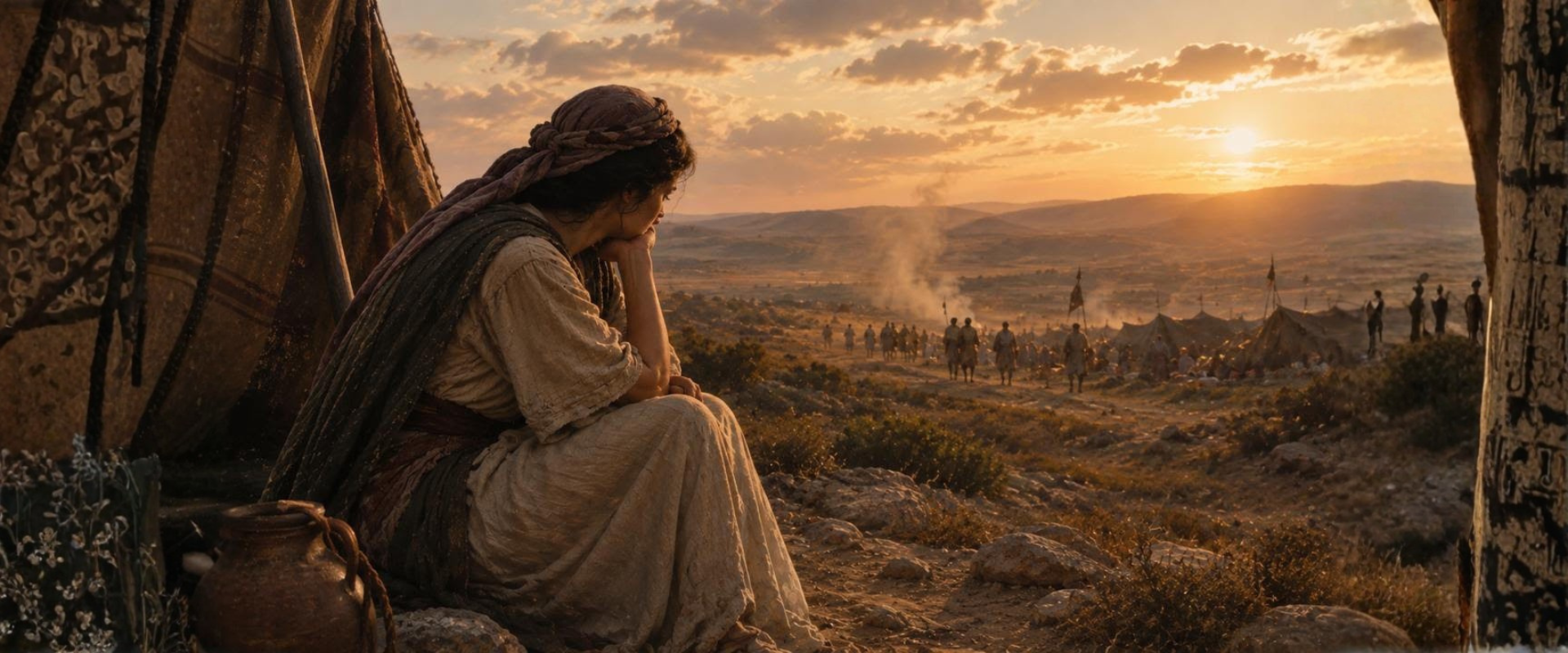
And therefore, specifically Song of Songs, and specifically this verse, are a gift. Because the verse doesn't say, "After a long and grueling process, after you complete all the stages, your beloved will arrive." It says, "The voice of my beloved! Behold, he comes." Behold. He. Comes. Present tense, a sense of closeness, a sense of suddenness. The mountains that are leaped over – they don't disappear. They are still there. The hills don't crumble. The difficulty doesn't deny itself. But leaping over them is possible. The change doesn't have to go through every mountain and every hill – it can surmount them. Times change. Often surprisingly. By skipping stages, by "leaping over the hills." Of all the blessings I received for the holiday, the one that most struck me was a very short blessing from our friend Steve Stolman from New York, who will be celebrating his 95th birthday in a few weeks, and has already been through many things in life. 


Stay Safe. Stay Strong. Have Faith. Times Will Change. You are not alone. Have a Good Passover


Times will change. This does not mean not to advance the change and sit with folded hands, but rather to believe that the pendulum of life, and also of the lives of nations, "leaps over the mountains and climbs the hills.".


And I wanted to share another simple thought: "Shir HaShirim" – which can also be read as "a song to songs," a song that sanctifies poetry itself. Music is one of the most ancient tools people have to cultivate hope within themselves. Not through argument, not through sight, not through explanation – but through melody. Rabbi Nachman of Breslov said there is no remedy for sadness like joy, and no tool for joy like a melody. And throughout our history – in exile, in bondage, in hardship – we sang. We sang because the melody reaches places words cannot.


And in this sense,.


The Song of Songs opens with a question: "Let him kiss me with the kisses of his mouth." A direct, personal, touching plea. The Knesset of Israel turns to her beloved and says: Come. Here I am. I am here.


This Passover, we too can stand with this plea. Not out of perfection, not out of confidence that everything is already okay – but out of the belief that the beloved is leaping over the mountains toward us, that change can come suddenly, and that the melody we will sing tonight invites him to come. "The voice of my beloved, behold, here he comes."


Shabbat Shalom and happy holidays.

Picture of אסטבן גוטפריד

Esteban Gottfried

Rabbi and CEO of Beit Tefillah Israeli, and one of its founders. Lives in Tel Aviv, married to Ruthi and father to Maya and Tobi.

Parashat Tzav

Words for Shabbat - A community blog for this week's parashah

Parashat Tzav

Between the Eternal Fire and the Eternal Lamp

 
By Rivi Dror
 

The Book of Leviticus, which we began reading last week, is also known as "The Law of the Priests." The book deals with the service of the Tabernacle: the activities, duties, and roles of the priests, as well as the concept of holiness and the role of the Jewish people as a holy nation.


In last week’s parashah, Vayikra, we read about the types of sacrifices an individual could offer; whereas in this week’s parashah, Tzav, we encounter the laws governing the priests" service in the Tabernacle and their daily duties. The morning in the Tabernacle begins with the cleansing of the altar of all the remains of the sacrifices that were burned on it during the night. One priest is chosen to remove the "trumat ha-dashan,” a small portion of the burnt remains, and place them at the foot of the altar, on the eastern side, facing the rising sun. Afterward, the priests clean the rest of the ashes and carry them outside the camp, to a pure place.


Right from the very first task of the day, a dual movement becomes apparent: there is manure that is brought in—and manure that is removed. There are aspects of the past that we choose to keep close, as a memento and a reminder, and there are aspects of the past that we must clear away to make room for a new beginning. The addition of fertilizer and the removal of fertilizer point to an inner tension: every day is part of a chain of days, of tradition, of generations; and at the same time, it is also a new day, seeking to begin "with a clean slate," with renewed strength and will.


After the grain offering has been prepared, the wood is arranged on the altar, and the fire is kindled in preparation for the morning burnt offering. A fire burns constantly on the altar:


“A fire shall be kept burning on the altar—it shall not go out.” (Leviticus 6:6) On the day the Tabernacle was dedicated, fire came down from heaven and took hold of the altar before the eyes of the people. From that moment on, the fire on the altar is a continuation of that revelation, but the responsibility for it passes to humanity. For even a fire of divine origin requires hands to tend it, to feed it, and to ensure it does not go out. Therefore, there are always glowing embers in the corner of the altar—a fire that must burn constantly.


The eternal flame is a fire of action. It cooks, transforms, and consumes matter. It is part of daily life, of physical, repetitive work—the kind that can sometimes become an automatic habit.
Precisely for this reason, kindling the fire on the altar every day requires the priest to remain fully present in his actions—not merely to perform them, but also to pay attention to what is happening. When an action is performed out of habit, without paying attention, it does not merely take place; it also accumulates.


Every fire leaves behind ashes; every action leaves behind debris. This debris is not merely waste. The act of clearing away the debris teaches us that there are things from the past worth preserving and keeping close by, as a reminder. Clearing away the debris reminds us that not everything is meant to be kept; there are also things to be discarded, to make way for a new beginning.


To tell them apart, you need light.
As we gaze upon the eternal flame, we are reminded of the eternal lamp described in the parashah Tetzaveh in the Book of Exodus.
"And you shall commandthe Israelites, and they shall bring to you pure, crushed olive oil for the light, to keep the lamp burning continually" (Exodus 27:20). As part of the preparation of the Tabernacle, the people are commanded to bring pure olive oil to "keep the lamp burning continually." The eternal lamp burns inside the Tent of Meeting, within. It is the westernmost lamp among the branches of the menorah. The priests must ensure that it never goes out, and every evening the other lamps of the menorah are lit from this one. What is the connection between the eternal fire and the eternal lamp? Why must both burn constantly?


The eternal flame is at work in the world, transforming it. It sets a process in motion—but also leaves a remnant behind.
The fertilizer reminds us that life is not just about what we do, but also about what remains with us from those actions.
And the eternal flame—the light that burns within—allows us to return to what remains, to find meaning in it, and to carry on even when the path is not entirely clear.
The light of the eternal flame is a light that does not burn out, but rather accompanies us.


In these days when reality itself is ablaze, and our daily routines are repeatedly shattered, it seems as though fire is all around us. We need a light to illuminate our choice: what from these days will remain with us, and how we will carry what remains. That same light will also enable us to see the good in people, what still functions and is good in our reality, and the light of faith. It is important to know that if the eternal flame goes out, it is rekindled only from the eternal flame itself.


Perhaps we can learn from this that even the gentlest light sometimes needs a spark that comes from action, from the world, from encounters with others. "We are with you, you are not alone"—this is not merely a slogan we shouted to the mothers of the kidnapped, but it continues to be spoken and cried out at other demonstrations where the public seeks to support and empower those whose voices are not heard enough.


May we know how to keep the fire burning: to act, to participate, to be part of it; and may we also know how to tend the candle: to shine, to see, to discern; and may we know, anew each day, what to take from the ashes and what to let go of—and may we have the strength for all of this.


Shabbat Shalom!

Picture of ריבי דרור

Rivi Dror

Rivi is a rabbi in the Israeli House of Prayer community, lives in Pardes Hanna, and is the mother of two daughters. .

Parashat Ki Tissa

Words for Shabbat - A community blog for this week's parashah

Parashat Ki Tissa

What happens when the leader disappears?

 
By Meir Tzohar
 

The "Because you will carry" It is one of the most dramatic in the Torah, ranging from spiritual exaltation to the depths of the sin of the golden calf. The order of events is not chronological (the census takes place only a year later in the Book of Numbers).

The parashah opens with a census, conducted by means of a uniform contribution of half a shekel, which will be used to build the Tabernacle. It then details some of the Tabernacle's vessels and appoints craftsmen to carry out the work. Further details on the commandments of Shabbat complete the opening of the parashah (with the linking of the commandments of Shabbat to the construction of the Tabernacle serving as the traditional interpretation for the formulation of the list of 39 types of work prohibited on Shabbat). 

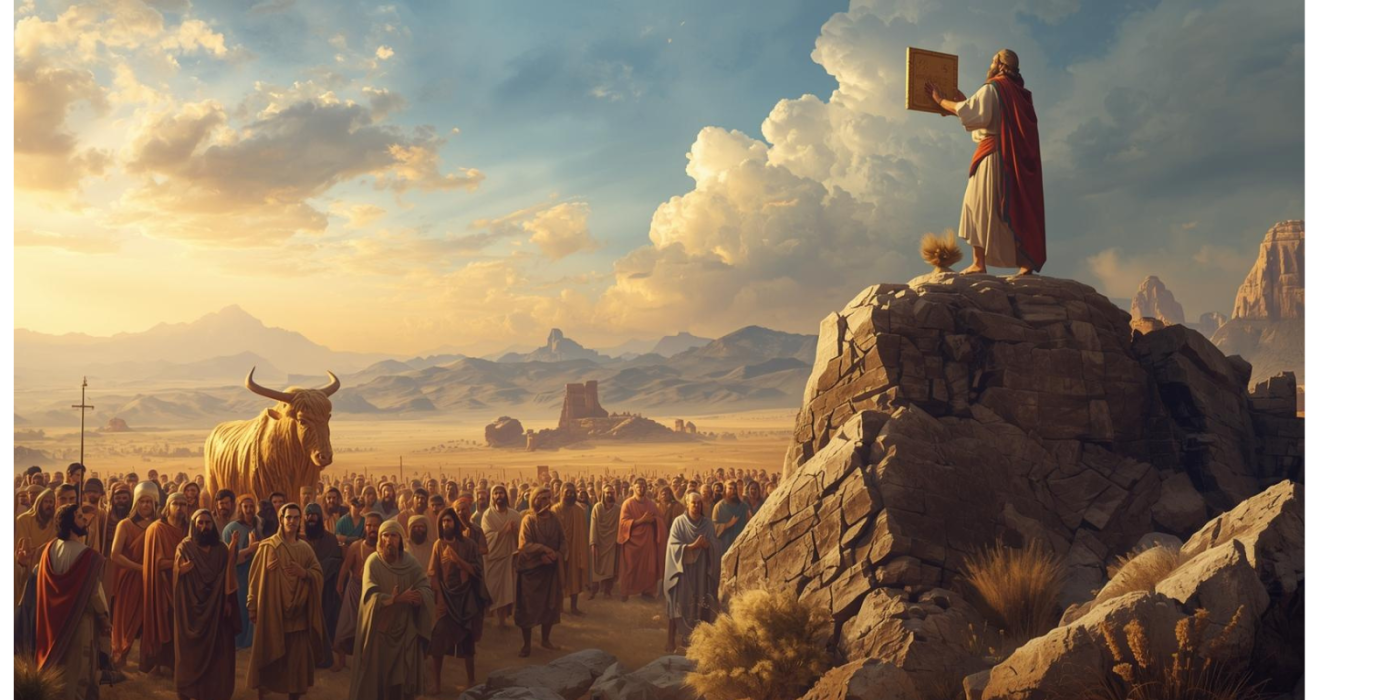
The main part of the passage deals with "The sin of the golden calf" – the original sin of Israeli/Jewish culture for thousands of years. Moses delays on the mountain for 40 days. The people, under pressure and anxiety, demand a replacement for Aaron. Aaron creates the The Golden Calf. God informs Moses of the sin and wants to destroy the people. Moses prays for the people, but when he comes down and sees the dancing around the calf, he Breaks the tablets of the covenant. Moses punishes the sinners with the help of the Levites, who pass through the camp and kill 3,000 people. Afterward, Moses climbs the mountain again to ask for forgiveness. He asks God, "Please show me your glory." In response, God reveals to him the The Thirteen Attributes of Mercy , the main prayer for asking forgiveness to this day.
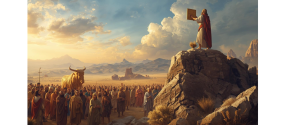
 

Moses carves new stone tablets. After another 40 days, he comes down with The second tablets. Due to his immense closeness to God, Moses' face is glowing The light was so strong that he had to put a veil over his face when he spoke to the people (statues of Moses with horns throughout Europe originate from a faulty translation). 


From "We will do and we will hear" to "The sin of the golden calf"

The connection between "We will do and we will hear" and the sin of the golden calf seems, at first glance, to be a complete contradiction. How could a people that had reached a spiritual state of self-nullification ("We will do" before "We will hear") crash and burn within forty days into idolatry of a golden calf? However, when we look at the psychological sequence of events, we can see in the sin of the golden calf Direct continuation The extremism of "we will do and we will hear," and an ancient expression of FOMO, the fear of missing out.

"We will do and we will hear" – spiritual ecstasy without preparation

The mass cry"We will do and we will hear." expresses a state of ecstasy. The Israelites gave up intellectual understanding and critical thinking ("we will hear") in favor of total commitment ("we will do"). It is a moment of spiritual "high" in which the boundaries between man and his beliefs become blurred, and man loses control.


The challenge:  Peak moments pass quickly. As soon as Moses ascended the mountain and the fog took over, the people were left in a vacuum of faith. Without the "hearing"—that is, without deep understanding, critical thinking, a gradual process, and tools to contain the spiritual experience in everyday life—enthusiasm quickly turns to anxiety. When Moses was "late" in coming down, the emptiness turned to fear, and the people sought a security blanket.


The sin of the golden calf FOMO   collective

FOMO is the fear that something important is happening and we are not part of it, or that the source of our security/happiness has disappeared and we have been left behind. After 40 days, the people develop a "film" of anxieties and fears:

The fear of losing the leader: "For this is Moses the man... we did not know what had become of him." The people are afraid that their connection with God has been severed and that they are "missing out" on the opportunity to continue the experience of Sinai.

The need for "here and now"":  FOMO requires quick solutions. The calf was not an attempt to rebel against God, but an attempt moor The same in substance. The people need "a God who will go before us"—a God who can be seen with the eyes, who is available and immediate, who does not require waiting in the fog.

Social pressure: As on social media, the anxiety surrounding the sin of the golden calf feeds on itself. "And the people gathered around Aaron" – this is a movement stemming from social pressure and mass anxiety that "everyone knows something I don't know" about Moses' disappearance.


Dealing with the FOMO – Building a "safe place" for anxiety


The sin of the golden calf teaches us that we cannot live only by "we will do and we will hear," by moments of peak emotion and blind faith, without building everyday tools. The calf is "Shortcut" To achieve a sense of "divinity" without going through the work, the waiting, and the uncertainty. The Tabernacle is a correction – Unlike the calf, which was created in a moment of outburst and anxiety, the Tabernacle was built with detail, painstaking work, and planning. It teaches that the way to deal with spiritual FOMO is not by chasing instant gratification, but by creating a routine of sacred work.


The second tablets Moshe's sculptures reinforce the motif of Sisyphean labor versus religious and spiritual ecstasy. The most significant difference between the panels is their origin. The first panels were """The work of God is the letter, and the letter is the work of God.""". They represent a gift from heaven, a total experience that requires no human effort—like the initial "We will do and we will hear." In contrast, in the second set of tablets, God commands Moses""" Carve two stone tablets like the first ones.""" . Here, Moses is the one who must carve the stone, and God "only" writes on them. 


The first boards were like a perfect "story," everything looked amazing and effortless—  "We will do and we will hear.". The second tablets are a correction—they teach that holiness requires Hard work and genuine involvement. We cannot rely solely on divine ecstasy; we must carve out the tools ourselves so that we do not fall apart in every moment of anxiety and difficulty.


In the Midrash Exodus Rabbah, it is recounted that Moses regretted breaking the first tablets, but the Holy One, blessed be He, comforted him, saying, "Do not regret the first ones, for they contained only the Ten Commandments, but in the second tablets I give you more than that." Halakhot, Midrash, and Aggadah"Here too, the Midrash teaches that it was precisely the breaking and repairing that gave rise to a new depth – theOral Torah. FOMO seeks the quick answer, but the second boards represent the longer, more interpretive, and richer path that develops alongside the individual. 


The Gemara in Bava Batra (14b) notes that both the complete tablets and the broken tablets were placed inside the Ark. """broken slabs """Asher Shiber Moshe. From this we can learn that profound correction does not ignore situations of brokenness. Correction does not mean ignoring failure, but rather making room for brokenness. Brokenness reminds us that even failures (such as the sin of the golden calf) have value. Failure is part of the story. The attempt to be "perfect" (as in the first tablets) is what causes anxiety and leads to brokenness. Accepting brokenness allows us to cope and grow. 

Summary

The sin of the golden calf is the story of a people who rose too quickly and too high in "We will do and we will hear.", and were unable to cope when their leader disappeared. The fear of being left alone in the fog without a tangible God drove them to create a glittering substitute in the form of the golden calf. And so today, we too must remember that it is precisely in moments of uncertainty, crisis, and difficulty, when we feel that we are "missing out" or being left behind, that the wise thing to do is not to run after shiny, fast-moving "golden calves," but to patiently build up inner strength that will carry us even when the fog covers the mountain.

Picture of מאיר צהר

Meir Tzohar

Meir Tzohar - eternal student... Vered's other half, father to three grown children and grandfather to four amazing grandchildren and Polymath...

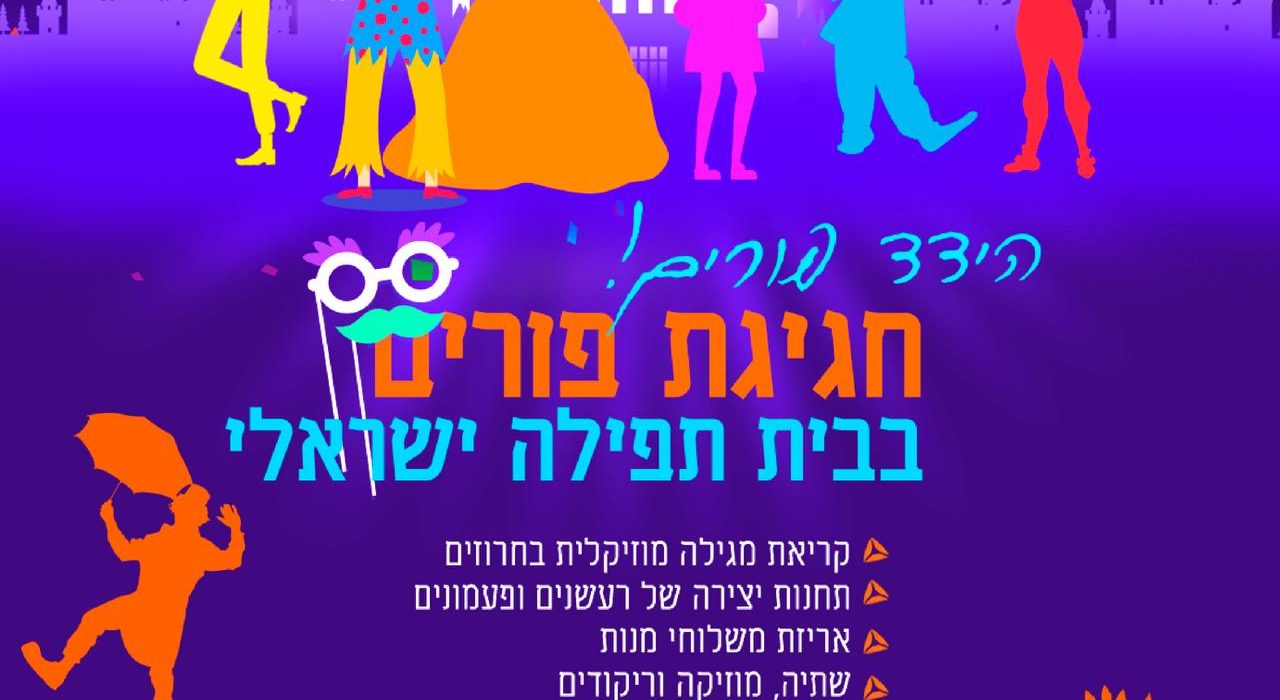
Purim 2026 at the Israeli House of Prayer

Purim 2026 at the Israeli House of Prayer

Musical Megillah reading and many more surprises!

Purim in an Israeli house of prayer
Monday, March 2, 2026, 6:00 p.m. to 9:00 p.m.
Why can't Purim come twice a week?
This year it's coming – and in a big way!
 Happy Purim at the Israeli House of Prayer 
You are invited – young and old alike – to a particularly joyful and entertaining evening.
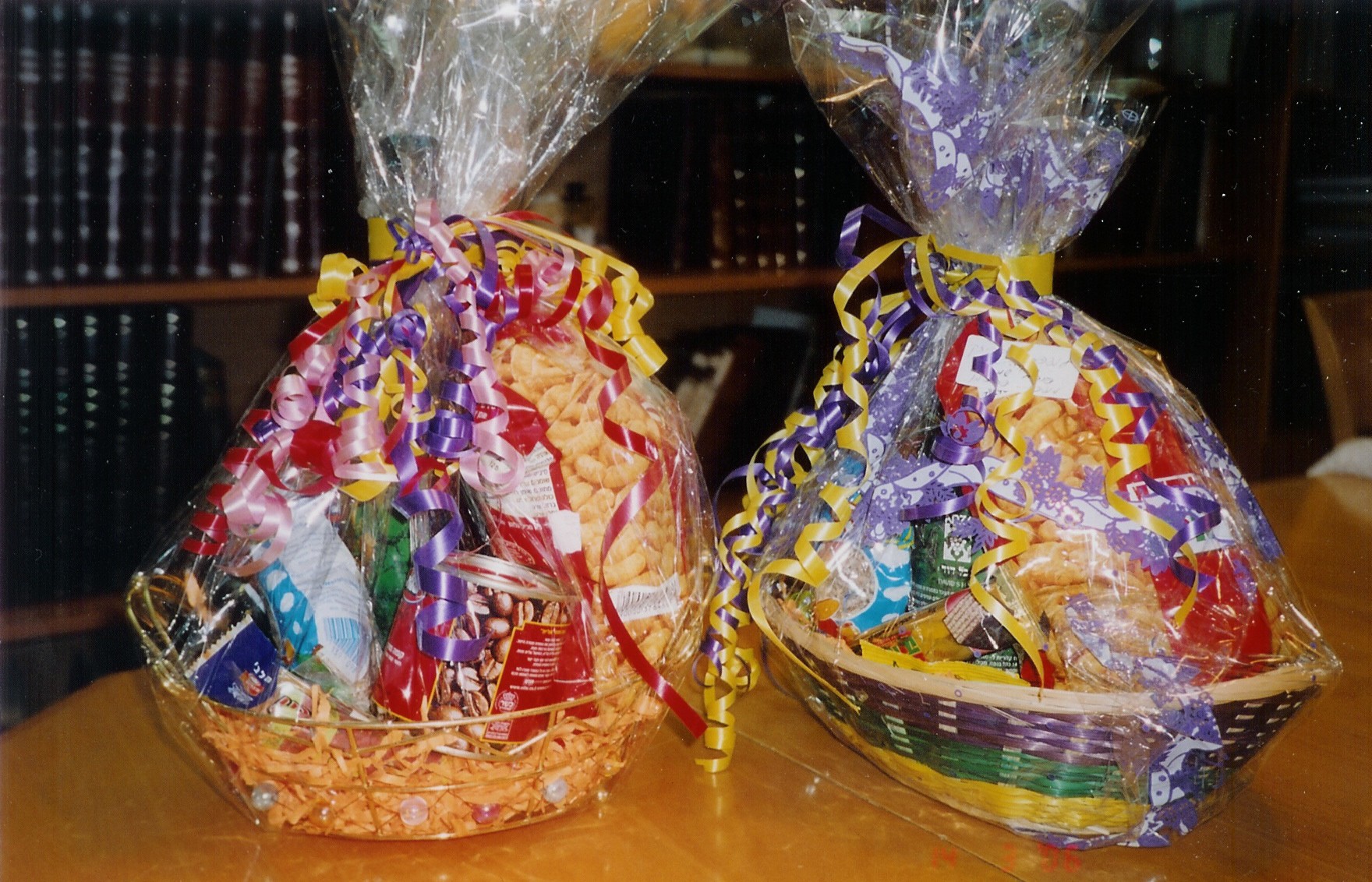
Let's start with a workshop on making noisemakers and packing gift baskets.,
We will continue reading the Book of Esther in verse accompanied by live music, and conclude with refreshments and a communal toast.

Miracles and salvation, joy and jubilation, the hidden is revealed and the lowly is exalted—and everything turns out for the best!

We are collecting 50 NIS from anyone who wants to participate in sending food parcels from the House of Prayer to needy families in Tel Aviv. 
Please click on the link and send your donation.
 On Monday, March 2, 26
 6:00 p.m. – Gathering, packing food parcels, workshops, mingling, and good vibes!
7:00 p.m. – Musical Megillah reading with the Beit Tila Israeli ensemble
 
 At home, peace be upon you, Bar-Kovitz 2, Tel Aviv
Come celebrate with us! 


Where: Beit Shalom Aleichem, 2 Bar-Kovitz Street, Tel Aviv.

Delivery of food parcels to the needy in Tel Aviv

This year, we are collecting 50 NIS from each participant who wishes to do so, in order to purchase food parcels for needy families in Tel Aviv. To purchase a food parcel, click on the link.

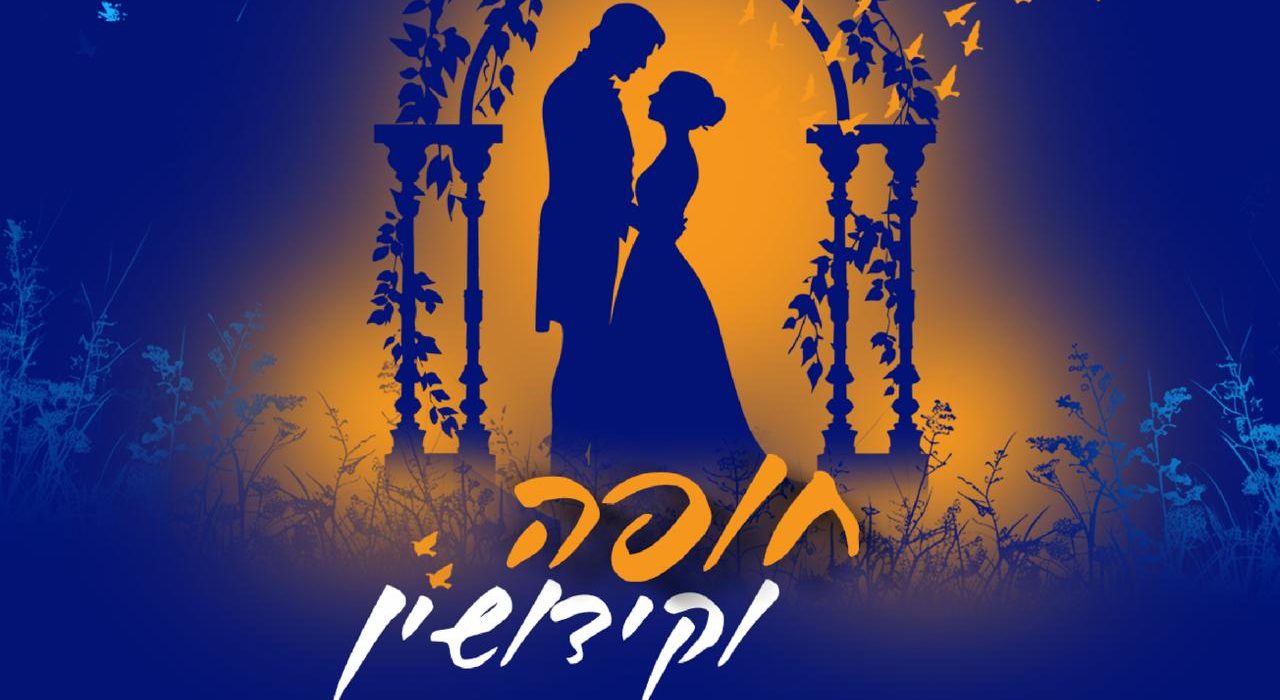
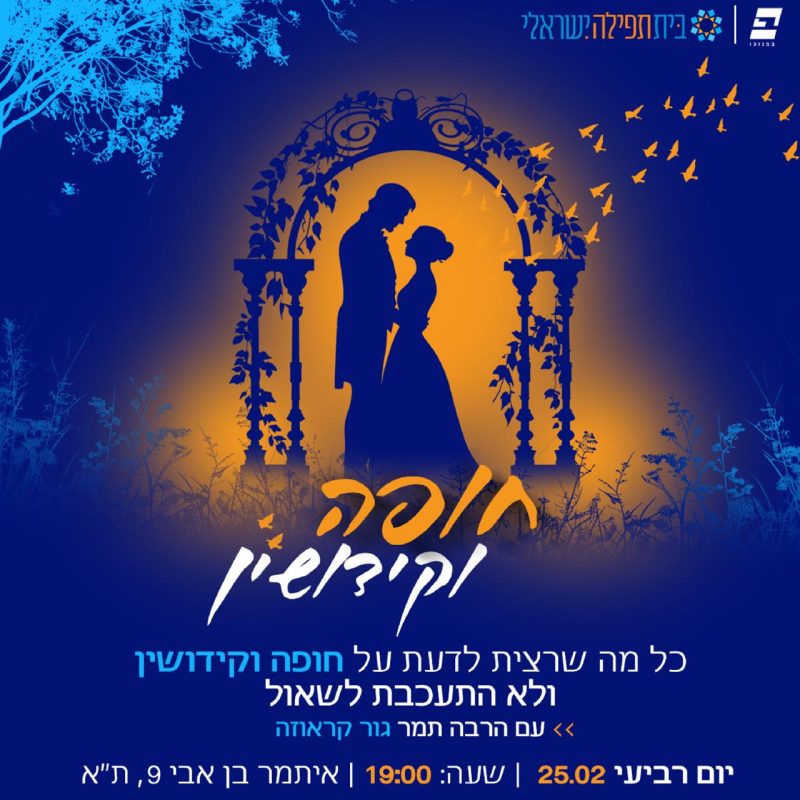
As part of "L'chaim" – a series on life ceremonies: wedding canopy and marriage ceremony

Wedding canopy and betrothal

Everything you wanted to know And you didn't hesitate to ask
On the wedding canopy and the wedding ceremony

WhatsApp Image 2026-02-16 at 1.55.15 PM

Tradition and innovation in one word

What really happens under the chuppah?
When did rings become part of the ceremony? Who can perform a wedding?
Why do we break a glass—and has it always been there?

You are invited to a special class with Tamar Gur-Krause—the woman who has married the most couples in Israel.

Let's dive into the history of the chuppah:
From its ancient roots, through its halachic and cultural development over the generations, to the new forms it takes today.
We will examine the ketubah, the blessings, the rings, and the breaking of the glass—and ask what lies behind them.
We will also discuss the legal situation in Israel and how to create a ceremony that is relevant to modern life without losing touch with tradition.

A gathering for learning, conversation, and sharing.

Wednesday | February 25, 2026 | 7:00 p.m.–9:00 p.m.
"Bafnoko" space"
9 Itamar Ben Avi Street, Tel Aviv.