The Parsha of Korach

Words for Shabbat - A community blog for this week's parashah

The Parsha of Korach

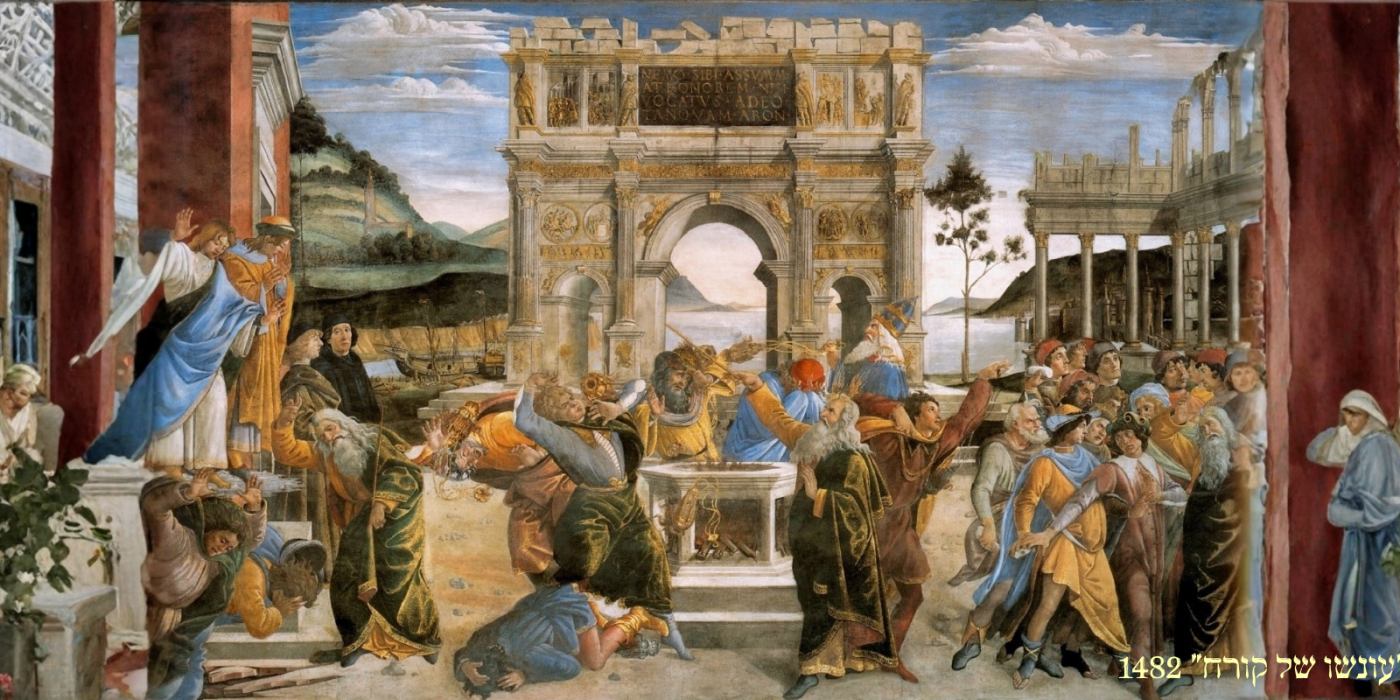
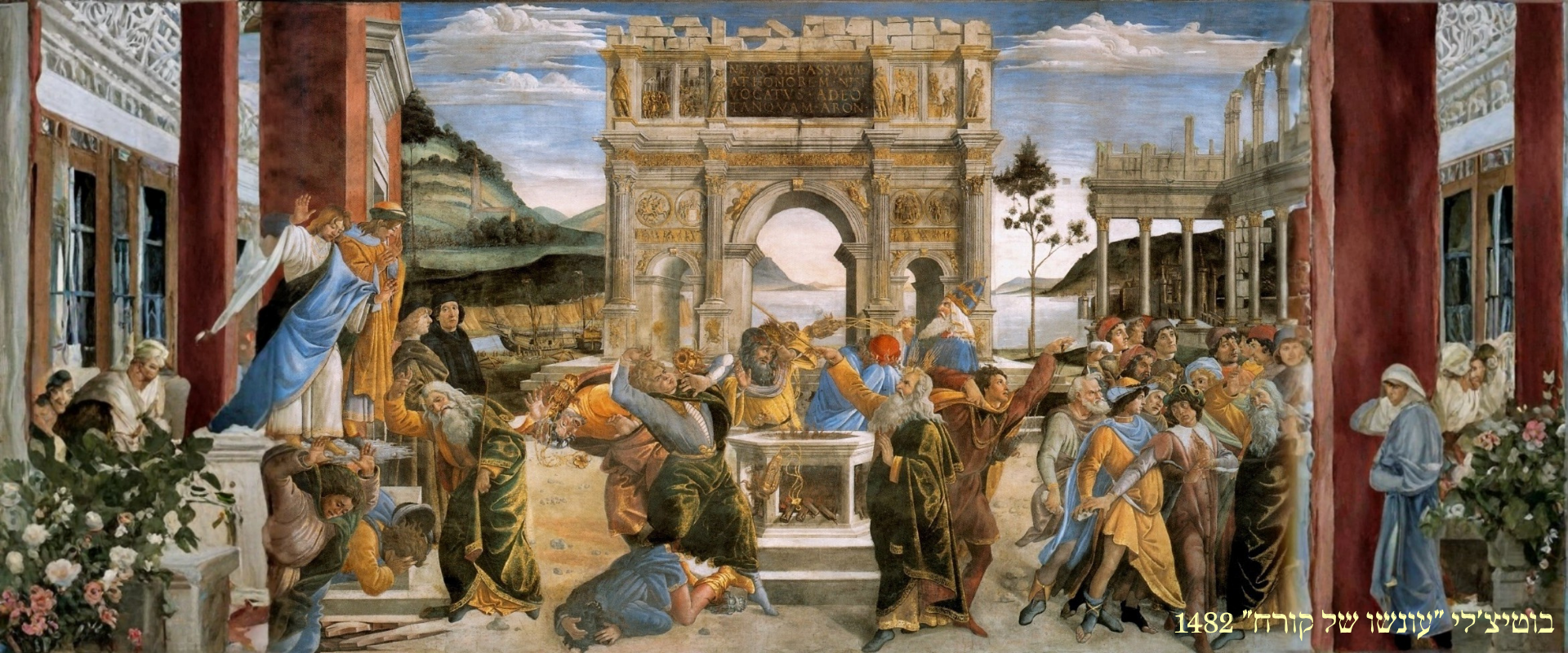
From a claim to office - to dedication to holiness

From: Rivka Bakalash

I'll start with a personal confession,
The parashah 'Korach' is perhaps my least favorite parashah in the entire Torah.
This is a portion that denounces independent, critical thinking, and the right to criticize the leader, the chosen of God.,
And indeed, there are many leaders who claim to be God's chosen.
The parashah speaks out against the right of rebellion, "and they rose up before Moses" (Num. 16:2), the right of assembly: "and they gathered together against Moses" (Num. 16:3), and the right of protest.
And the text emphasizes that these are not marginal figures, but "two hundred and fifty heads of the Karaite community, men of renown" (16:2).
Moses" initial reaction: "And Moses heard, and fell on his face" (16:4).
Some commentators explain that he did so out of distress, while according to another opinion, he prostrated himself before God to ask Him to reveal to him what he should answer and what he should do. In my critical reading,
And in the spirit of current slang, Moshe's reaction was "the worst.".
However, later in the incident, when God informs Moses and Aaron of the punishment He intends to inflict upon the rebels, "they shall be separated from this community,",
"and will consume them right now" (Num. 16:22), Moses and Aaron gather themselves and this time their response is: "God of the spirits of all flesh, shall one man sin and You be wrathful with the entire community?" (Num. 16:22).
This response echoes Abraham's response in his argument with God, in his attempt to save Sodom from destruction. In Moses' case, his claim against divine judgment,
 Here is evidence of a sense of responsibility for the entire community, a collective responsibility, unlike his initial reaction, which stemmed from personal insult and selfish motives.
And Moses, in order to emphasize before the people that he is not motivated by personal reasons, says, "Hereby you shall know that the Lord has sent me to do all these deeds,
 For it is written (TLBZ 28), and it even adds, "And you shall know that these men have rejected the LORD" (TLBZ 30). The rebellion is presented as a rebellion against the LORD, and not just against the chosen of the LORD, Moses and Aaron.
And despite the terrible punishment of Korah and his company, and the divine intervention – the acceptance of Aaron's offering – the protest did not subside and even spread and intensified.
 "All the congregation of the children of Israel murmured against Moses and Aaron, saying, 'You have killed the people of the Lord."" (Num. 17:6).
God is angry with the people and a plague breaks out, which Aaron manages to stop with the incense. But the lesson is that neither the incense gives life nor the incense causes death, but rather the will of God.
The incense, which was an expression of Aaron's election by God, now functions to save the people from the plague. God's choice of the High Priest, Aaron, is a responsibility and obligation to act for the people.
The work of the Levites in the Tabernacle is defined by Moses as the separation of the Levites from the congregation of Israel: "to bring you near to Him, to do the service of the Tabernacle of the Lord, and to stand before the congregation to minister to them" (16:9).
The word "to sacrifice," which Moses uses, has a double meaning. The Levites were brought close to the service of God, brought close to the sanctuary. But this closeness is also a sacrifice, for they are servants of the community in the sanctuary.
This is a task and mission for generations to come.
An entire chapter at the end of the Torah portion is dedicated to describing the rights and obligations of the Levites and priests, emphasizing the fact that the Levites have no inheritance like the other tribes.
They are dedicated to sacred service; their existence depends on the tithe the people are commanded to set aside for them, and they too must set aside a tithe for God – for the priests.
"They shall not share in the inheritance of the Israelites. (18:23)" God's choice of the Levites and priests is not an advantage, but a sacrifice, a calling, and a commitment.
And the desert section to my right, here and now.
If we read the Parsha of 'Korach' as a continuation of the Parsha of 'Shlach Lecha' – the Parsha of the Spies – it emerges that a period of turmoil and uncertainty breeds factionalism, jealousy, and envy.
And one can hope that as reality changes, the disputes will be settled...
And from the lesson of the portion, since holding office is not a privilege, but a dedication to holiness, rises the hope that those who serve in "holiness" and those close to power,
This proximity will also be seen as a sacrifice, of working for the good of the people and the country.

Picture of רבקה בקלש

By Rebecca Bakalash

"The helper opposite" Reuven "The helper opposite me," mother of three and happy grandmother of seven. Doctor of Intertextual Art and Visual Culture.

Parashat Shelach

Words for Shabbat - A community blog for this week's parashah

Parashat Shelach

What is the connection between the "Lech Lecha" portion, Ben-Gurion, "The Silver Platter" by Nathan Alterman, and Aharon Barak?

From: Ruti Shapira

The parashah "Shelach Lecha" (in the Book of Numbers, chapters 13-15) primarily deals with the sending of the twelve spies to scout the land of Canaan, and also includes the punishment of the one who gathered wood on Shabbat and the mitzvah of tzitzit.

The sin of the spies led to the decree of 40 years of wandering in the desert. According to Yona Bar-Maoz of Bar-Ilan University, the instruction to send spies to scout the land is attributed to God, and their careful selection as well, 'all of them chiefs among the children of Israel,' was "at the command of the Lord" (Numbers 13:3). Nevertheless, the outcome of the mission was very negative and unexpected; the spies did indeed begin with praise for the land: "We came to the land to which you sent us.'
"And also milk and honey it flows and this is its fruit' (Numbers 13:27), but immediately added and argued that its conquest would be problematic: 

For the people who live in the land are very strong and the cities are very large and fortified, and we saw the descendants of the giants there. Amalek dwells in the land of the Negev, and the Hittites, the Jebusites, and the Amorites dwell in the hill country. 

The sin of instilling fear in the people was not the main sin of the chosen spies, but another, surprising sin: 

and they brought up an evil report of the land The land that we passed through to explore is a land that devours its inhabitants, and all the people we saw in it were men of great size (Numbers 13:32). 

It seems that speaking ill of the land was particularly severe, as it could have affected the second generation of the Israelites leaving Egypt, not just the current generation, which naturally struggled to transition from a mental state of servitude to one of freedom. 

If the younger generation believes that the land is not good, as ten chosen men of good standing have said, they might even sin like their predecessors and wish to return to Egypt.

The swift death of all ten distinguished individuals, due to speaking ill of the land, convinced every listener that they had indeed lied, while Caleb and Joshua were correct in their claim: "The land is very, very good" (Numbers 14:7). 

The evil report about the land affected the spirit of the people and their sense of ability to fulfill the divine vision. Perhaps if all 12 spies, chosen by God, had returned with enthusiasm from the promised land,
And strengthening the divine promise made to them several times, that they were going to the "Land flowing with milk and honey," their listeners would have responded differently. They might have rushed enthusiastically toward the first destination that crossed their path, and the first victory would have strengthened their spirits and proven to them that conquering the entire land was possible with God's help. 

Rabbi Jonathan Sacks argued that the spies who instilled fear in the hearts of the people did so because of the difficulty of detaching themselves from the warm embrace of God, who was within the camp, protecting it through miracles, wonders, and signs, and providing them with manna. Their mentality was that of slaves who could not break free from their dependency and go to war, to human battles that would inevitably involve sacrifices. Therefore, it was necessary to eradicate the generation and raise a new generation, one that was not a generation of slaves.

And I thought about the Declaration of Independence of the State of Israel, which took place on Friday, the 5th of Iyar, 5708, May 14, 1948. Ben-Gurion, a relatively old man who was already over 60, had to make a fateful decision against the backdrop of the threatening giants of his time: Syria, Iraq, Jordan, and Egypt, who threatened to invade and fight the young state. He had no divine promise, nor a promise of miracles. But he had a connection to the sources and a vision, and he made a historic decision despite the expected war with the giants.

Sovereignty in the Bible and in today's reality is not granted to a nation on a silver platter. Sovereignty requires the courage to make decisions, faith, and sacrifice.

The poet Natan Alterman wrote this in his famous poem: The Silver Platter:

She will prepare for the ceremony. She will stand facing the moon.
And she stood, before the day, cloaked in festivity and awe.
Then a maiden and a youth will come out from the other side
And slowly, slowly they will march towards the nation.

Wearing pants and belts, and heavy shoes,
Along the path they shall go, and be silent.
They didn't change their clothes, they didn't wash again in the water
The traces of the day of toil and the night of the fire line.

Tired to no end, monks of rest
and Hebrew dewdrops of youth drip --
The two will approach and stand without moving.
And there is no sign whether they are alive or wounded.

Then the nation, drenched in tears and sorcery, will ask
"Who are you?" she asked, and the two were silent.,
They will answer her: We are the money tray.,
that the Jewish state was given to you.

The young woman and the young man, two warrior figures, announce that they are "the silver platter," meaning the vessel upon which Hebrew sovereignty was granted and established in the land. Their struggle, and also their literal selfless death and conscious sacrifice, is for its sake.

To his right, I will conclude with a quote from Professor Aharon Barak when asked about the protests against the judicial overhaul: 

"A people unwilling to fight for their freedom may not be worthy of being a people.

So we have a land and we have a country, but the struggle for its character is not over. Unlike a nation, an individual cannot extinguish within themselves 40 years of old beliefs that prevent them from realizing a vision. We don't have the time for that. I invite you to examine yourselves, to see what was important for you to fight for in your life, to make sacrifices, or to gather courage and new beliefs in order to confront the challenges in your life.

 
Picture of רותי שפירא

Ruthie Shapira

Group facilitator, literature teacher, personal coach. Mom to three grown kids and a fun grandma to two sweet granddaughters. Addicted to stories. Loves traveling.

Parshat Behaalotecha

Words for Shabbat - A community blog for this week's parashah

Parshat Behaalotecha

Living in the Cloud: On Uncertainty, Meaning, and the Wisdom of the "Here and Now"; Between Sinai and Tokyo.

A. The Problem: The Desert Madness Routine
Parashat Behaalotecha presents us with one of the most fascinating – and psychologically exhausting – descriptions of the life of the Children of Israel in the Sinai Desert. The Torah describes in unusual length how the entire camp moved according to the movement of the Divine Presence cloud.
"And when the cloud was lifted from over the Tabernacle, the Israelites would set out, and in the place where the cloud settled, there they would encamp. . . . Sometimes the cloud would remain from evening until morning, and when the cloud lifted in the morning, they would set out. . . . or for two days, or for a month, or for days [a year] . . ." (Numbers 9:17-22)

Try for a moment to imagine this situation on a human, everyday level. Entire families, elderly people, children, tents, animals, and possessions. You arrive at a station, unload your equipment, set up the tent, and get the kids settled for sleep. In the morning, you wake up, the cloud lifts – and you have to pack everything up and set off again. On the other hand, sometimes you are parked in a desolate, boring, and uncomfortable spot, and you are stuck there for a whole year without knowing when you'll be able to move.
There is no schedule. There is no five-year plan. There is no ability to plan for tomorrow. The Torah presents us with a reality of extreme uncertainty, nerve-wracking, and almost impossible to control.


B. The Distant View: Israeli Helplessness and Japanese Awareness
I am writing these words from Japan, where I have been for the past few months. Observing Israel from here evokes deep thoughts about this concept, uncertainty.
The current Israeli reality feels exactly like the desert in the Parshat Behaalotecha. Israeli society is living within a thick cloud of immense and exhausting uncertainty: Will war break out again in the north? What will happen with Iran? When will elections be held? The collective feeling in the country is that we have lost the ability to plan even a week ahead. This uncertainty breeds constant anxiety, deep frustration, and a sense of helplessness.
But here in Japan, in the heart of a culture of over a hundred million people, completely removed from Jewish tradition, I encountered a very different worldview.
In Japanese tradition, conceptually and culturally, there is a fundamental Buddhist concept called "Anicca" - the law of impermanence. According to it, the natural state of the world is that everything flows, changes, and is temporary. Nothing is permanent: not the political situation, not health, nor the weather. The Japanese developed an entire philosophy called Mono no aware.
(Mono no aware), meaning the awareness and sensitivity to the transience of existence
While we, in the West and in Israel, perceive impermanence as a disaster and a threat to be fought, Japanese culture actually finds beauty and inner peace in it. The most familiar example is the cherry blossom (sakura) – it is beautiful and celebrated with immense excitement precisely because it lasts a week or two and then falls. The Japanese do not try to stop the cloud or time; they practice accepting the present moment, the "here and now.".


C. The Solution: What happened at the graves of craving?
And here we return to our portion, and discover that the Torah and Japanese wisdom meet in the exact same place.
Immediately after the description of the journey following the cloud, the people in the desert broke. The psychological burden of uncertainty overwhelmed them. They became "complalers," and cried at the graves of craving: "Who will feed us meat? We remember the fish that we ate in Egypt for free... and now our soul is dried up, there is nothing but the manna before our eyes.".
Psychologically, the people are sinning by fleeing. When they are unable to bear the uncertainty of the desert, they flee into a false nostalgia for the past—for Egypt. Although they were beaten slaves there, at least everything was fixed and known in advance. They are fed up with the manna.
What is manna? Manna is the ultimate food of the "here and now." It is given out day by day, and it cannot be stored for tomorrow (because it will rot), and it requires man to rely on the present. The people hated manna because manna forced them to live in that moment, without existential guarantees for the future.
The solution that the parsha offers us—and which harmoniously resonates with Japanese Zen—is the understanding that holiness does not reside in stability and absolute security, but rather in the ability to let go of control and dwell within the present moment. The pillar of cloud was not meant to stress the people, but to train them. The desert is a tough school for accepting impermanence. God tells them, and also us: You cannot control the cloud, you cannot know when you will travel and when you will return. The only thing you can control is how you behave in this moment, within your tent, with the people beside you.


D. Conclusion: Finding Calm Within the Cloud
The complex and painful Israeli reality will not change tomorrow morning. The threats and political and security upheavals will continue to accompany us for a long time.
But perhaps, this practice of the cloud page, combined with a bit of the quiet and humility of Japanese wisdom, could offer us a little relief.
Instead of exhausting our strength on existential anxiety about a future beyond our control, or on nostalgia for a past that is no longer, we can choose to focus on the "manna" of today. In the present. In our ability to build supportive and sensitive communities, like in an Israeli house of prayer; in the ability to meet the other, to sit around a Shabbat table, to listen, and to find moments of peace, sanity, and holiness within the fleeting nature of the journey.
The external reality may not change immediately, but who knows – our full and stable presence within the "now" can, in the end, wonderfully impact tomorrow. Shabbat Shalom


Picture of ווילי סיגל

Willy Siegel

A grandfather to two Swedish grandchildren, living with his family in the Netherlands, and currently in Japan for several months, getting rich from new beats.

Parashat Nasso

Words for Shabbat - A community blog for this week's parashah

Parashat Nasso

Parshat Naso, the second parsha in the Book of Numbers, continues the preparations for the dedication ceremony of the Tabernacle.
At the beginning, the sons of the tribe of Levi are counted, who were chosen to carry the tabernacle from place to place. Their very small number in relation to the other tribes presents difficulties in itself, and also in relation to the number of firstborns (22,273), which the Levites replace (out of over 600,000 Israelites, only one in 27 or more is counted as a firstborn).
The portion concludes with the dedication of the altar and the sacrifices of the tribal princes, and the list of gifts brought by each prince is repeated exactly 12 times (perhaps to show that the size of the tribe does not matter, or alternatively, that none of them were willing to have their name omitted from the list of gifts).
In the middle are three eclectic portions concerning ritual purity and impurity (the command to remove lepers and other impure persons from the camp, the laws of the Nazirite, and the strangest of all, the "Sotah portion" dealing with a magical ritual to identify women suspected of adultery).
The trial process of a woman who strayed refers to a woman who was warned to stop isolating herself with a man who is not her husband, yet she was found to persist in this behavior and is therefore suspected of adultery. During the ritual, she is required to drink bitter waters into which verses of imprecation (the curse) from the Torah portion (Numbers 5:18-22) are erased from a parchment. These verses include the text, among others, 'May the LORD make you a curse and an oath among your people, when the LORD causes your thigh to waste away and your belly to swell. May these bitter waters that bring a curse enter your body, causing your belly to swell and your thigh to waste away.' Drinking the bitter waters ends in one of two outcomes: either the woman emerges unharmed from the event, thereby proving her innocence and gaining a healthy offspring and renewed trust in her marriage, or she experiences severe pain and even dies if she is guilty. In any case, this is a supernatural process that includes many elements that contradict fundamental principles of legal process and justice according to Halakha.
First, unlike ordinary legal proceedings, which the relevant parties must attend, a woman suspected of adultery has the right to refuse to participate in the ceremony. In such a case, she is permitted to agree to the decision to dissolve her marriage and forfeit any right to payments due to her by virtue of the marriage contract (Mishnah Sota 4:2).
This is surprising because if the court had convicted her of adultery, she could have been sentenced to death – yet she is given the option to avoid legal proceedings if that is her wish.
Furthermore, direct intervention by the Creator in a dispute between man and his fellow man is not found in any other instance (and as Ramban notes (Numbers 5:20), this is the only commandment in the Torah whose fulfillment, in the case where the woman is found guilty, depends on a miracle). After drinking the bitter waters, "her belly swelled and her thigh fell away." In all matters between one man and another, we find a clear procedure whereby the responsibility for judgment in cases between man and his fellow man is given solely to the judges sitting in the courts (Deuteronomy 17:11). And perhaps this is also the place to mention that even in matters between man and the Creator, the Sages have removed the Creator's opinion from the discussion (Bava Metzia 59b - the oven of Akhnai).
Why, then, does the Creator of the world have a role in resolving this particular conflict?
Rabbi Aharon Soloveitchik believes that the purpose of the ceremony is the opposite of what is apparent, and when one carefully reads Tractate Sotah, it appears that its purpose is actually the rehabilitation of the relationship between husband and wife.
According to Rabbi Soloveitchik, the entire ceremony is a complex psychodrama designed to provide an opportunity to salvage a marriage on the line. If the wife is at fault, she has a low-risk alternative in the choice not to participate in the ceremony and instead to dissolve her marriage. Conversely, if she is not at fault, the ceremony gives her the opportunity to face the risk and show that she is confident in her marital fidelity.
The ceremony is not in line with the rules because its goals are not legal (and therefore the partner suspected of an affair is not a participant in the process at all) but rather rehabilitative, and it creates a platform for the dissolution or rehabilitation of the marriage.
And in contemplation of our present day. In the Mishnah (Sotah, 9:9) it is written that at a certain point, 'the waters of bitterness ceased' due to the changing needs and realities among the Jewish people. Similarly, the mitzvah of yibbum (levirate marriage), which was practiced and accepted in the past in cases where a married man died without children, has disappeared, and in our time, the default option is to perform chalitzah, which exempts the widow from marrying her deceased husband's brother.
It seems that as norms change, the adherence to the Torah and the preservation of its values are adapted to our changing world, and there is room to adapt current Halakha in other areas, such as agunot and refusal to grant a get.
On second thought - perhaps all the great effort surrounding the breakup of a single family stems from the Sages" answer to the existential question, "So what do you do all day?"
The Midrash (Genesis Rabbah 68:4) tells of a matron who asked Rabbi Yossi ben Chalaphta what the Holy One, Blessed be He, has been doing since the creation of the world. Rabbi Yossi replied: 'He sits and matches couples: This man's daughter with that man, this man's wife with that man, this man's money with that man.'.

The matron scorned the answer, claiming that matchmaking was an easy task she could perform herself. Rabbi Yosi replied to her: "If it is easy in your eyes, it is difficult before the Holy One, blessed be He, like the parting of the Red Sea.".
God of the universe sees his work falling apart and decides to intervene.
In previous parshiyot, I mentioned the importance of leadership that knows how to stand by essentials when facing a major event (Abraham in the argument over the fate of Sodom, Moses in "Blot me, I pray thee, out of thy book, which thou hast written" after the sin of the calf). Parshat Sotah shows us an example where the Creator commands to erase His name (erasing the verses that include God's name into the bitter waters) from the book in order to save one household.
And from here – to our lives.
While success is not guaranteed, if the Creator is willing to have His name erased in the case of a wayward woman to promote harmony and prevent injustice, surely we are called to do our part to ensure justice for those who have been wronged and for harmony to prevail in our homes.
Shabbat Shalom!


Picture of מאיר צהר

Meir Tzohar

Meir Tzohar - eternal student... Vered's other half, father to three grown children and grandfather to four amazing grandchildren and Polymath...

Parshat Behar-Bechukotai


Words for Shabbat - A community blog for this week's parashah

Parshat Behar-Bechukotai

"And your brother shall live with you."

Rabbi Kobi Weiss


Granting "mental resilience" to a person is a clear commandment and is even more important than the commandment of monetary charity. The prophet Isaiah details the best way for social repentance and says two similar verses: "Is it not to share your bread with the hungry and to bring the homeless poor into your house…?" (Chapter 58:7) "And if you spend yourself on behalf of the hungry and satisfy the needs of the afflicted…' (Ibid., 10) The first verse speaks of material aid to the needy, and in its continuation, the prophet Isaiah details six blessings that will come upon whoever fulfills it. The second verse is interpreted as dealing with aid for mental resilience – "and satisfy the needs of the afflicted" – and in its continuation, the prophet details eleven blessings upon it.


The Talmud (Bavli Bava Batra 9) summarizes: "Whoever gives even a small coin to a poor person is blessed with six blessings, and whoever appeases him with words is blessed with eleven blessings" – teaching you which form of assistance is more important and beneficial in God's eyes.


We will review several commandments concerning interpersonal relationships in Judaism and see how concern for the well-being and mental health of others is expressed in them. First and foremost, the commandments of charity, acts of kindness, and mutual responsibility in Judaism are based on the great principle around which everything revolves: "You shall love your neighbor as yourself." These commandments are not solely about material support. In order to love your neighbor as yourself, one must love oneself, and this is an emotional love that includes inner compassion and giving appropriate value to one's inner self. These feelings should be translated into providing inner resilience and self-worth to others.


Additionally, in the mitzvah of visiting the sick, we find that a central goal of the visit is to "revive the soul" of the sick person – to encourage their spirit and give them "peace of mind with their friends" – to give them a feeling that they are being cared for. The Ramban (Torat Ha'adam, Sha'ar HaMichush, p. 17)


Jewish law also views caring for the sick as part of the commandment of "returning a lost item" – to return to a person what they have lost, whether it be money, physical health, or mental health. We also have the commandment in this week's Torah portion: "And your brother shall live with you" (Leviticus 25:36), a commandment to sustain the other not only financially but also physically and mentally. This is fulfilled when the other person feels the community's embrace and feels that their life is not solitary but one of brotherhood. At the time of the giving of the Torah, the Midrash states: "Rabbi Shimon ben Yochai taught: At the time the Children of Israel stood at Mount Sinai and said, "All that the Lord has spoken we will do, and we will hear' (Exodus 24:7), at that moment there were among them neither those with abnormal discharges, nor lepers, nor the lame, nor the blind, nor the mute, nor the deaf, nor fools, nor the dim-witted, nor the simple." (Leviticus Rabbah 18:4)


The cry of "Naaseh v'Nishma" (We will do and we will hear) was not merely a surrender to observing the Torah from God before hearing it, but a deep connection of the people that included internal social responsibility – that all will do and all will hear. Here, there is a promise that there will be no outcasts among them, like those with flux or lepers who were outside the camp, nor those with disabilities who could not participate in the doing, nor those with mental impairments who could not hear and understand it. This description of the scene at Mount Sinai is an ideal example of "Love your fellow as yourself.".


We note the expression coined by Rabbi Shimon bar Yochai: "not desolate." Many post-traumatized people live among us. Research indicates that most citizens of the country have been affected in one way or another by the psychological stress of recent years. A large part of them are, in a sense, "desolate" – withdrawn into themselves, experiencing detachment and inner emptiness, and impaired in their ability to communicate optimally with their environment. In our Torah portion, it is written: "And if your brother becomes poor and his hand is weak with you, you shall support him as a stranger and a sojourner, so that he may live with you" (Leviticus 25:35). Only our outstretched hand – "you shall support him" – a personal hand and a group hand, will help. The support system must include the "father and mother" of the citizen – that is, the state and its institutions – to help alleviate the desolation created by events of national magnitude.


And finally—the mitzvah of comforting the mourners—its main purpose is psychological support and communal and social "hugging" for one whose world has gone dark. A central part of the laws of mourning is to create a process that accompanies the mourners in difficult moments and supports them so they do not fall and surrender to the inner darkness, but rather rise and return to full functioning in the community.


Freud already pointed out that there is no great difference between mourning and melancholy. The only difference lies in whether the mental state is accepted by the culture or not. Even one who mourns emotionally from all the tragic events we have experienced needs the same consolation – therefore, the blessings from Isaiah, which we mentioned at the beginning, are so fitting, dedicated to one who grants emotional strength – that his soul "satisfies" the other's soul: 'And your light shall break forth like the dawn, and your healing shall spring forth quickly; your righteousness shall go before you; the glory of the LORD shall be your rear guard. Then you shall call, and the LORD will answer; you shall cry, and he will say, "Here I am.’ If you take away from the midst of you the yoke, the pointing of the finger, and the wicked word, and if you offer your bread to the hungry and satisfy the desire of the afflicted, then shall your light rise in the darkness and your gloom be like the midday. And the LORD will guide you continually and satisfy your desire with good things, and you will restore your strength. And your house shall be like a watered garden, like a spring of water, whose waters do not fail. And your ancient ruins shall be rebuilt; you shall raise up the foundations of many generations; and you shall be called the repairer of the breach, the restorer of paths, and the inhabitant of ruins." (Isaiah 58:8-12).


Shabbat Shalom!

—————–

The organization "Rabbinical Voice for Human Rights," of which all rabbis from Beit Tefilah Israeli are members, dedicates the week of the Torah portion "Behar" to the issue of social justice each year and holds classes and lectures throughout the country.
This year, Social Justice Week is themed around the right to health – with an emphasis on mental health and the urgent need for supportive systems; resilience centers, and a robust mental health network that provides adequate coverage of doctors in the community offering timely services.

You are invited to explore the special website for Social Justice Week: https://www.socialjustice.info/

Picture of הרב קובי וייס

Rabbi Kobi Weiss

Kobi Weiss is the rabbi of the organization "Voice of Rabbis for Human Rights."

Parashat Acharei Mot–Kedoshim

Words for Shabbat - A community blog for this week's parashah

Parashat Acharei Mot–Kedoshim

"and the land will not vomit you out."

"and the land will not vomit you out"
(Inspired by Avi Sagi's article: Conversion, Exile, and Sovereignty - Reflections Following the Biblical Tradition)
In his commentary on the first verse of the Bible, "In the beginning God created the heavens and the earth," Rashi asks why the Torah began with this verse and not with the first commandment given to the Israelites: "This month shall be unto you" (Exodus 12:2).
And his answer: If the gentiles say to Israel, "You are robbers who conquered the lands of seven nations" (meaning the land of Canaan), answer them: The whole land belongs to the Holy One, blessed be He. He created it and gave it to whomever it pleased Him. By His will, He gave it to them, and by His will, He took it from them and gave it to us.
Is this process reversible (God forbid)? Meaning, taking Judea and Samaria from Israel and handing it over to others? If so, what could be the factors and conditions for that?
The Bible answers this in several places, including in our weekly Torah portion.
The reasons why God took the land of Canaan from the seven nations are mainly: the idolatry they suffered from, at its head the sacrificing of children (human sacrifice) to Moloch, incest, and their social-moral conduct.
And therefore the central command and warning is: "You shall not do as they do in the land of Egypt where you lived, nor shall you do as they do in the land of Canaan, to which I am bringing you, nor shall you follow their customs." (Leviticus 18:3) but rather: "You shall keep my statutes and my ordinances, by doing which a person shall live: I am the Lord." (Leviticus 18:5)
What is the required and appropriate conduct?
The detailed explanation of its central principles is found in Chapter 19 of the Book of Leviticus, a chapter that has become canonical in Jewish culture. At its head is the guiding principle: "You shall be holy, for I, the Lord your God, am holy," followed by a breakdown of behaviors that are appropriate for realizing this principle, primarily concerning interpersonal relationships, moral sensitivity and compassion, and great concern for the vulnerable in society (the blind, the deaf, the orphan, the widow, and the stranger).
A special dimension is known regarding the treatment of a ger—a ger in the Bible: an ethnic group not from Israel that lives among Israel. 36 times, the Sages counted references to the treatment of a ger in the Torah. Only to him is the demand "and you shall love him as yourself" (parallel to the commandment "and you shall love your neighbor as yourself") attributed: "And if a ger stays with you in your land, you shall not afflict him. He shall be to you as a native-born among you, the ger who stays with you, and you shall love him as yourself."
And the reason for this is: "For you were strangers in the land of Egypt, I am the Lord your God' (Leviticus 19:33-34).
The remembrance of the Exodus from Egypt and the obligation to remember the slavery and subjugation in Egypt is the foundation and source of inspiration for a series of commandments toward the stranger, orphan, and widow—the socially weak margins of society.
Why has the attitude toward the stranger become a central touchstone for proper moral conduct?
The biblical tradition directs the people of Israel to their land. The Land of Israel is the home of the people, but even within their home, they are called upon to constantly experience the feeling of being strangers in their own land. And all of this is for what reason? Out of concern for developing a master-servant attitude.
The historical memory of slavery and migrations in Egypt is the foundation for developing an awareness of the need for constant confrontation with the danger of power and dominion that lies in wait for anyone living in a land that they rule without restraint.
The people of Israel are not an indigenous people, masters of the land and its absolute owners, nor will they be made so.
The land is God's gift to Abraham and his descendants under certain conditions. Man is not sovereign, and therefore should not develop a consciousness of mastery, "and you shall not say, "My own strength and the might of my hand have produced all this wealth for me."
Therefore, God takes the trouble to warn the people of Israel and to inform them, that just as He brought them to the land, so He can also destroy them. The way to contend with the temptations of sovereignty is by developing a disposition of awareness of being strangers and of conditional existence in this place.
And we will conclude with the words of Samson Raphael Hirsch, adapted from the verses in Leviticus 18:24-28 in our portion:
"Since the selection of Abraham and his land, the Land of Israel does not tolerate the corruption of its inhabitants. The flourishing of this land depends on the moral flourishing of its inhabitants—those born within it, nourished by its fruits, and enriched by its treasures. In the completeness of man and his moral freedom will be found completeness for the land as well. The land forfeits its purpose if the society upon which it depends has corrupted its ways and forfeited its own purpose. Therefore, a society that is socially and morally corrupt has no future in this land... Just as the body expels foreign matter within it, so too will the land expel its inhabitants.
It is difficult to write these things without thinking about the chasm that yawns between the position of the Bible and the deeds performed night after night, and even in broad daylight, by the "hilltop terrorists" in Judea and Samaria. Those who claim to act in the name of Judaism and to fulfill the commandments of the Bible are distorting the legacy of us all.
These lines are written with considerable pain and great concern, just a few days after we celebrated 78 years of our renewed sovereignty and independence in our homeland.
Shabbat Shalom! 

Picture of יעקב קסטל

Yaakov Castel

Holds a Master's degree in Jewish History from the Hebrew University, a retired Lieutenant Colonel; served as Head of the Education Department in the IDF General Staff, and has been involved in and managed training, teaching, and education in various bodies over the years.

Holocaust Remembrance Day gathering

Holocaust Remembrance Day gathering and testimonies

Holocaust Remembrance Day Gathering - T.A.A.C. Committees

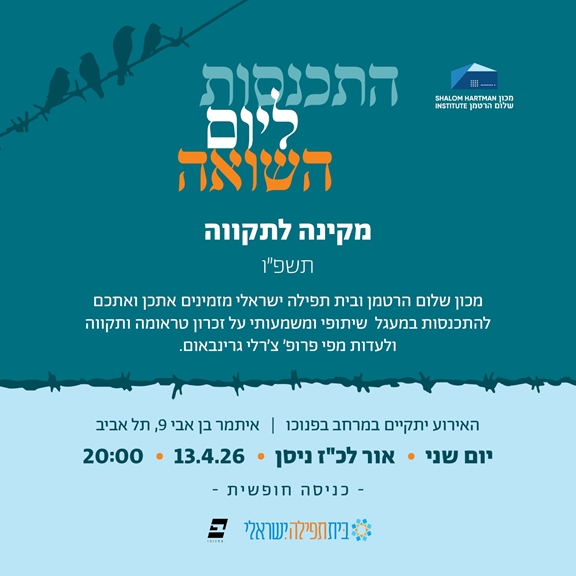
Holocaust Remembrance Gathering - "The Responsibility to Remember and Remember Responsibly" This year too, we will mark the "Gathering" ceremony. We will meet on Monday, April 13, 2026, at 8:00 PM for an hour in which we will together take responsibility for the memory of the Holocaust. We will say Kaddish, hear testimony, and remember our family members who perished and the communities that were and no longer are. This year we will hear Charlie's testimony: At the office of an Israeli synagogue: 9 Itamar Ben Avi Street, Tel Aviv. Admission is free. Please register in advance.

Parashat Shemini

Words for Shabbat - A community blog for this week's parashah

Parashat Shemini

Between Responsibility and Guilt – Leadership in Times of Crisis

 
By Ronen Koehler
 

Parashat Shemini opens at a moment of climax: the eighth day of the inauguration of the Mishkan. After seven days of preparation, fire appears from heaven and validates human work. This is a moment of connection between heaven and earth, between human initiative and divine approval. But precisely within this moment of climax, a great rupture occurs: Nadav and Avihu "take initiative" and offer 'strange fire, which He had not commanded them," and they die by fire that came forth from the Lord. The sharp transition from spiritual elation to disaster shakes the reader, but it also sharpens a fundamental principle: where there is holiness, there are also boundaries; and a leader bears heavy responsibility, not only for the role and its limits, but for the entire public, because they represent the entire public.

At the beginning of the parsha, we encounter Aaron at a pivotal moment: his entry into the role of High Priest. However, instead of enthusiasm or confidence, the Torah hints at hesitation: "Draw near to the altar" - Moses has to call him, to urge him on. The Sages describe Aaron as one who was "ashamed and afraid to approach." Why? This can be understood on several levels:

Awe: The direct encounter with the Divine Presence evokes a natural trembling; the memory of the sin of the Golden Calf – Aaron carries within him a deep sense of guilt and asks himself if he is worthy of being the one to atone for the people; and also the psychological transition from being "number 2," a partner and advisor to Moses (but without public responsibility), to the status of the official leader, the "High Priest.".

And there is also another dimension here: true leadership begins with recognizing the depth of responsibility. Aaron understands that the role is not just an honor but a heavy mission towards the people. He is the one who must stand between the people and God, atone, represent, and bear. Here Moses intervenes and tells him: "This is why you were chosen!" Not because you are perfect, but because you are willing to bear responsibility.

And opposite Aharon, the balanced and calculated (some would say hesitant), stand his sons Nadav and Avihu – the galloping horses. The second generation that takes on leadership sometimes without understanding its true cost. They are the sons of a High Priest, full of passion for serving God. But it is precisely this passion that leads them to transgression: 'strange fire which He had not commanded them." Our Sages offer various explanations: drinking wine, pride, independent ruling. But the common denominator is clear: action without sufficient responsibility to the framework and the community. They acted out of a desire to draw closer, perhaps even to intensify the spiritual experience. But they did not ask the central question a leader must ask: What is the meaning of my action for the system? For the people? What is the purpose of our leadership? They saw themselves at the center, not the role.

When a leader conflates their social role with their personal considerations, they damage public trust, the stability of the system, and trust in leadership itself. We see in the State of Israel the terrible price we pay when leaders misunderstand their responsibility to the whole and mix their personal interests with it. This, of course, happens in the Israeli government, but unfortunately, it also happens a lot in the IDF and other places based on leadership. Commanders and managers absolve themselves of responsibility by claiming "they are not to blame." Blame requires proof. Responsibility is inherent in the definition of leadership. When we demand a state commission of inquiry, we are demanding that our leaders allow other people to examine their performance and responsibility in order to learn and fix things, not necessarily to punish.

But, at the moment of crisis, Moses reveals himself as a complete leader.

He not only interprets the event, nor only manages it. He understands he is responsible for the entire nation: for the understanding of the event, for preserving trust in the system, for the continued proper functioning of the Tabernacle, and for maintaining Aaron's position as leader. Moses does not look for culprits; he does not ask "Who is to blame," but rather asks "What is needed now to hold the public together.".

And this is a critical point:

True leadership is not just about inner truth, but also about public influence. A leader must ask: Do my actions strengthen the public or undermine it? Do they create stability or chaos?

In summary, three main challenges arise from the case:

  1. Aaron's Hesitation to Lead: Am I worthy? Am I capable of bearing the responsibility towards the public?
  2. The temptation for Aaron's descendants to innovate without limits: The desire to influence, to innovate, but without considering the broader consequences.
  3. Moshe's ability to bear systemic responsibility for holding people, the system, and the public accountable, especially in times of crisis.

Leaders always operate under pressure, criticism, and a constant desire to show initiative. But the affair reminds us of a simple, uncomfortable truth:

Leadership is not a privilege – it is a responsibility to the public.

This responsibility requires:

Consider every action not only by intention but also by expected results.

To understand that an initiative that is not coordinated or controlled can damage public trust.

To know how to distinguish between guilt and responsibility: not to get stuck searching for culprits, but to move forward to conscious choice and correction.

And remember that every decision is examined not only at the moment but also by its impact on the entire social fabric.

Responsibility is a choice to act in a way that serves the greater good, even at personal cost.

True initiative is not just the courage to act—but the wisdom to understand when and how to act.

Today's leadership requires balancing humility with initiative, boundaries with freedom, and most importantly, remembering:

The leader does not act for himself. He carries an entire public on his shoulders.

Leadership is both a resource and a journey.

Shabbat Shalom!

Picture of רונן קלר

Ronen Koehler

Social activist, Chairman of the Israeli Prayer House, Lt. Col. (Res.), Organizational Consultant, and father of 3 from Tel Aviv

Leviticus

Words for Shabbat - A community blog for this week's parashah

The Book of Leviticus

Words for Shabbat

""Turn it over and turn it over, be absorbed in it" is what is said about the Torah: Study the Torah from all sides, because each time a different and new aspect and interpretation of the Torah can be revealed. This year we are renewing ourselves with a new section in the newsletter: "Words for Shabbat" - each week we will publish in the newsletter and on the Beit Tefilla website a Torah passage - a few words about the week's parashat from one of the community members and Beit Tefilla staff. And just as their faces are different, so are their opinions - we will wait to read the personal interpretation and learn what the encounter with the parashat brings up in them.

Parashat Vayikra

Words for Shabbat - A community blog for this week's parashah

Parashat Vayikra

Leviticus - Thoughts on Sacrifice

 
By Rani Jaeger
 

And the LORD called to Moses and spoke to him from the tent of meeting, saying:
Speak to the children of Israel, and say to them: When any of you bring an offering to the Lord, you shall bring your offering of livestock: of cattle and of sheep.
The Lord called to Moses and spoke to him from the tent of meeting, saying,


As a rabbi preparing boys and girls for their bar mitzvah, the Book of Leviticus presents an immense challenge for writing a sermon. The reason is simple: from the first portion and throughout the entire book, entire chapters are dedicated to the laws of sacrifices – among the most difficult subjects for contemporary Jews to grapple with, and a Jewish practice that has not been observed for nearly two thousand years since the destruction of the Temple.


The question of what to do with entire portions of the Torah that are read and have no (and perhaps it's good they have no...) connection to reality – let's set that aside for another discussion. But if ritual sacrifice is not part of our lives – the word "korban," in its many meanings, is very much present!


Prof. Moshe Halbertal, known to many of us and from whom I had the privilege to study, dedicated an entire book (in English) to the concept of the sacrifice. In several interviews conducted around the book's publication, Halbertal presented the findings of his research regarding the 'biography" of the word: "The first meaning of the word "korban' is the biblical meaning, and it is - 'korban,' in the sense of 'to bring near',' its parallel being the mincha (offering). Just as one "brings near" a korban, one "places" a mincha. The korban is a gift, but it is a gift whose transfer from the giver's hand to the receiver's hand is not guaranteed. Therefore, you only "bring near," because you don't know if the korban will be accepted or not.


The second meaning is 'victim' – the victim of rape, the victim of murder. It's an interesting question what connects these two meanings. I think it's related to the fact that the biblical sacrifice is a sacrifice with innocence. The animal must be pure, innocent, in order to be sacrificed. The modern Hebrew sacrifice is also innocent. But this is a very late meaning, which only begins to appear at the beginning of the 20th century; when Jews were massacred in pogroms in the Middle Ages, they were not called 'sacrifices'...


The third meaning, which is also very late in Hebrew, is the meaning of 'to sacrifice for': 'I sacrificed for my children,' for example, or 'I sacrificed my life for a certain cause.'" In interviews with him, Halbertal warns that in our time – within the concept of sacrifice lies also a dangerous mechanism of reversing affinity, meaning, a situation where the value does not justify the sacrifice, but rather the sacrifice sanctifies the value; instead of sacrificing for something holy, the act of sacrifice itself makes the goal holy and immune to criticism.


This process can create a "license" for violence, where the aggressor perceives themselves as a victim and thereby frees themselves from the shackles of conscience. From this perspective, even the binding of Isaac can be seen not only as a story of faith but as a moment where the victim of conscience turns the sacrificer into a captive within the cycle of power and aggression of his faith.


I find Habertas's analysis illuminating: identifying the three layers of the concept of "sacrifice" – the ritual act, the innocent victim, and the altruistic sacrifice – allows us to re-examine the rituals and values that shape our lives. The transition from "sacrificing to…" to "sacrificing…" is the junction where it is determined whether sacrifice is a path to closeness and connection, or if it is a tool to justify power and violence.
This understanding is especially crucial for us today, as we seek to establish a Jewish and Israeli identity that does not sink into an all-permissive victim consciousness, but rather one that aspires to action characterized by responsibility and morality. This is how the Hebrew language and the portion have brought us back to a concept that is not only not confined to the distant past, but the opposite: the concept at the heart of the portion clearly presents us with the sharpness of the choice before us and the magnitude of the challenge in shaping our lives. This may be the great call of "Vayikra.".


Shabbat Shalom!

Picture of רני יגר

Rani Jaeger

Rabbi Dr. Rani Jaeger, co-founder and co-rabbi at Beit Tefila Israeli, directs the Ritual Center and is a research fellow at the Shalom Hartman Institute. He is a father of four and a new grandfather.